The Footprint of the Past
The Footprint of the Past
When I first moved to New Orleans, my soon-to-be husband and I would visit restaurants in the West End area of the city near the Lakefront. West End is a man-made rectangle of land on the shore of Lake Pontchartrain. Back then, it boasted of such culinary establishments as Brunings, The Bounty, and Fitzgerald’s, as well as many others. After we were married and our first son had just been born, I would wait out in the car with the baby while my husband ran into Fitzgerald’s to take out a seafood platter for us to split back home. And I have to tell you, it was quite a treat.
But once we moved away from the city and Hurricane Katrina hit, all of those restaurants were gone, and to this day, none are rebuilt in that area. I often see people online in New Orleans groups saying, “Remember those restaurants at West End!”
Across the street from them, around a series of boathouses, was a park, just a walking park filled with trees and benches here and there. Well, in digging around the past for my novel, The Alchemist’s Bride, I discovered there used to once be much more. In the late 1800s and early 1900s, there was a popular amusement park in that very spot often called the “Coney Island of New Orleans.” It was filled with rides, hotels, restaurants, and a boardwalk. But there is not a trace of it anymore, except that sedate walking park. To this day, many people don’t even realize that it ever existed.


And with all of this, there is one more thing. Between West End and Pontchartrain Boulevards, there is a broad, long, well-landscaped neutral ground now filled with trees, grass, and sidewalks. On a hill near its center is a Celtic cross. In my time in New Orleans, we would often pass that cross, wondering why it was there. Once I found out about West End Amusement Park, I also found out there was once a great canal in that very spot called the New Basin Canal. It was a shipping canal built with the intent of connecting Lake Pontchartrain through the swamp land to the uptown section of the city. In 1831, Irish immigrants were brought into the city as cheap labor for this project. An estimation of 8000 of these laborers died during its construction, many from yellow fever and cholera, working in the swamp water to build the canal. And this enigmatic Celtic cross commemorates that loss of life. But so many don’t know this history, unless you dig to find it. And as a result, that cross stands silent and mysterious to most.
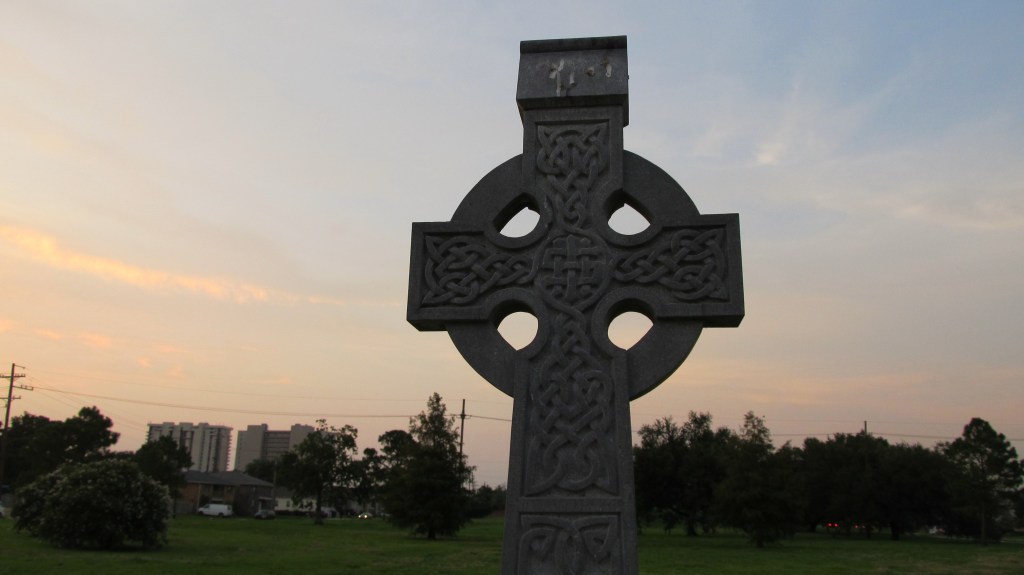
I suppose the point is that there is a precariousness in forgetting and even suppressing history, distorting facts. It so important to remember the good and the bad so that it can always serve to illuminate our steps in the future.
 Evelyn Klebert