City of the Dead

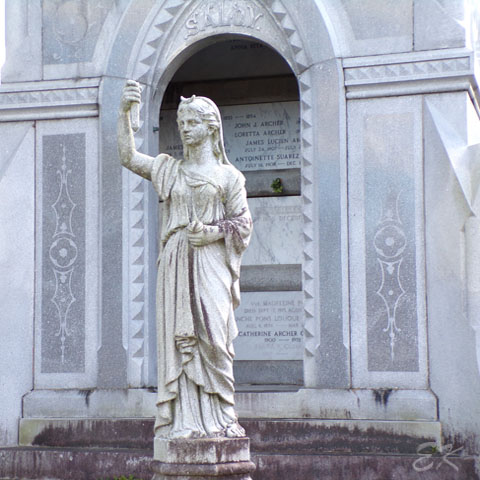
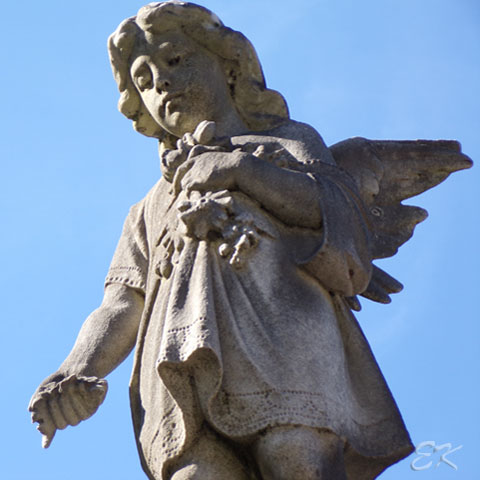
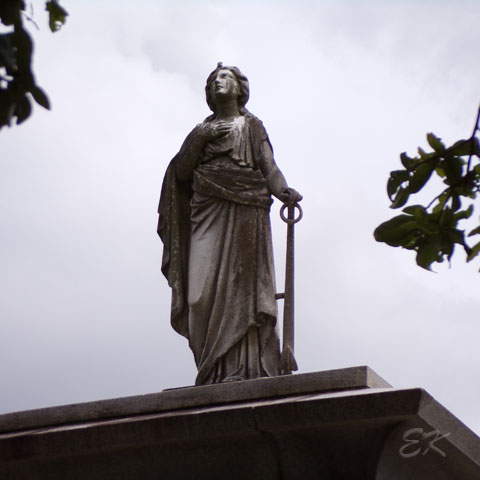
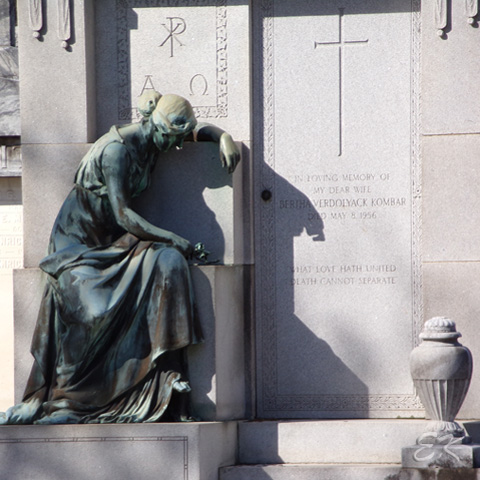
Recently, I have featured one of my novels, Sanctuary of Echoes, on the home page of this website. The Metairie Cemetery, located in New Orleans, dominates and figures prominently in the plot of this particular book. I have spent a lot of time over the years walking its quiet pathways and taking photographs of its magnificent statues and structures. The site was actually previously a horse racing track, founded in 1838 and later converted into a cemetery in 1872. The cemeteries in the New Orleans area are often referred to as Cities of the Dead as so many ornate above-ground crypts exist that house generations of families. If you ever get the chance to spend some time walking through these old cemeteries, you’ll understand that instead of only a place to remember those who have passed on, the statuary and monuments stand as a type of museum, marking time with its haunting and exquisite craftsmanship. I’m posting some of the photographs below that I’ve taken over the years.

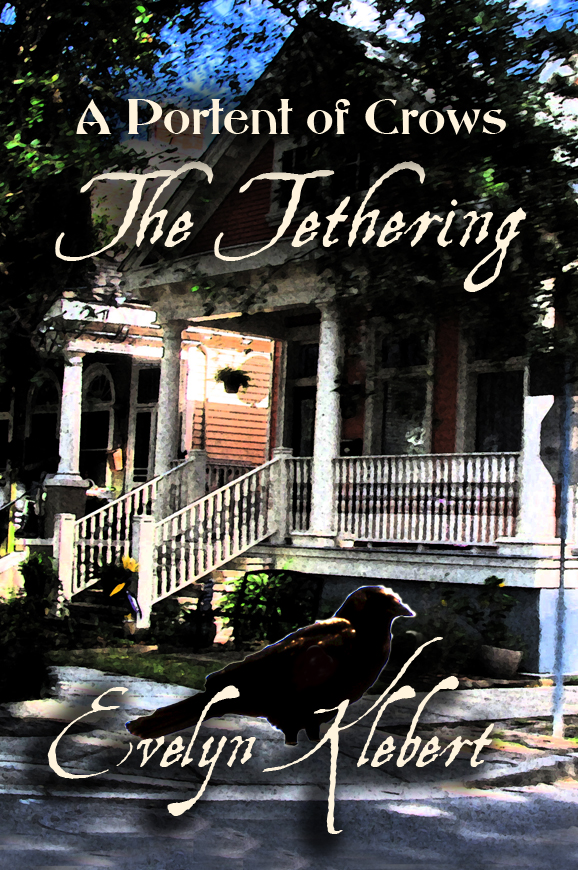
The Tethering: A Portent of Crows – Just Released!!

My new paranormal romance, The Tethering: A Portent of Crows, has just been released at Cornerstone Book Publishers, Amazon, and most other on-line print and eBook platforms.

Deborah Brandt’s beloved Aunt Gena always told her that she was special, a bit different, and would have to live her life unlike other people. Of course, this she disregarded as the ramblings of her lovely but notably eccentric aunt. Although there were the things that Aunt Gena said that seemed true — like Deborah being sensitive to energy shifts, having potentially psychic impressions, and dreaming of a spirit guide — none of it could be real. But the most ridiculous thing that her Aunt Gena told her before she died is that there is someone special out there for her. She said that he is an extraordinary man who is not only her perfect match but someone who she would learn from so that they could help the world in difficult times. How ridiculous! It sounds like a fairy tale, and no such person exists.

Daniel Wren is unique. He has been raised and trained from a young age to hone his psychic gifts. He lives in a world unimagined by most. And he has been waiting for years to contact his counterpart, soulmate if you will. But the problem is that she is painfully unaware of the type of life that he lives and the life she would be entering into if they came together.

His dilemma becomes how best to proceed. How can he win her over and move forward before outside forces take that decision away from him?

The Prince Adept

I am pleased and so happy to announce this new release by an exciting author who just happens to be my son. The Prince Adept is a mesmerizing dark fantasy by Robert Leo Poll that plunges you into a magical but embattled landscape where the only hope for humanity lies in the hands of a desperate alliance of bedraggled and unlikely heroes. Take this epic and unforgettable journey this summer.

The book is now available at Cornerstone Book Publishers (Print $21.95 on Sale $17.56), Amazon, and Barnes and Noble, and the eBook ($3.99) at Kindle, The Nook, I-Tunes, Kobo, and many other on-line retailers.

2021

Deep within the murky depths of the ancient, ruined city known as Hiri Handi, a lost traveler gathers the last broken dregs of humanity into an alliance. The hope is to finally close the supernatural, primeval seal tied to the very heart of their world — a seal that was selfishly wrenched open long ago, plunging Hiri Handi into a horrific abyss of terror.

A story of monsters, magic, and madness, The Prince Adept is a dark tale centered around the subtle ties that bind all of humanity together.

The Sojourners – Halloween Month

Well, this month has certainly flown by as I am getting ready to post my last paranormal yarn for Halloween Month. “The Sojourners” is a story that was first published in Dragonflies: Journeys into the Paranormal. It is the tale of a mother and daughter living in a turn-of-the-century haunted Virginia homestead. “The Sojourners” is a piece I wrote some time ago when I was in rural Virginia, as it was, living in an old Virginia farmhouse that I have little doubt was indeed haunted. I do hope you enjoy it, and I want to take the opportunity to wish everyone out there peace and calmness of mind during these trying times. After all, there is no greater treasure in all the world than peace in one’s heart.

Take care and enjoy the rest of this Halloween season.

The Sojourners

Everything leaves behind an impression — a footprint, the pressure of someone’s hand, fingerprints, scratches on a floor, reflections in a mirror, voices raised in anger. Somehow, an impression remains, and if it is strong, there is no erasing it except by wiping the slate clean.

Without understanding, there can be no growth. But I’m not sure that there is any understanding here. So starting at the beginning seems impossible, perhaps improbable. The beginning began long ago, long before me, most of us, I think. But the ending came just two days ago. The paper said that the storm came relentlessly, pounding along the Virginia coast. The devastation to its small counties had not been seen in over half a century. And I didn’t have to read it or hear it to know that nature’s rage had completely enveloped that farmhouse and reclaimed it utterly. There could be no other end, I think. And now, perhaps there can be hope again. What had been has been wiped away.

But our beginning there, or shall I say interlude, was less dramatic but perhaps intense enough in its own right.

My daughter Cathleen’s eyes were as big as saucers and as blue as the sky. They took in everything and, at the tender age of twelve years, took no prisoners. “As you can see, Mrs. McCallister.”

“Ms,” I stated abruptly. It wasn’t a correction I had to point out often in the city. But here in the heart of rural, although granted coastal, Virginia, I shouldn’t be surprised at the chauvinistic attitude directed at a single woman with a young child.

“Sorry, then, Ms. McCallister. As I said, my wife and I are very interested in preserving the integrity of the homestead.”

“Homestead, Mr. Hawkton?”

His gaunt face stretched wider with the perpetual grin that seemed forever planted on his visage. “The house was my parents’ and has been in the family for over a hundred years.”

I attempted a smile, but I was hot and irritated by our new prospective landlord, no matter how much I wished it were otherwise. “Well, that being the case, I wonder why you would want to rent it at all.”

His grin dimmed a bit. Hadn’t he mentioned something about being a salesman of some sort? He certainly had that demeanor. Everything appears pleasant, but all is a thin veneer beneath a much coarser core. “Well, you know how it is, Anna.” It was irksome that he’d taken liberties with my name. “Necessity drives us all. Candace, my wife, and I need to supplement our incomes, so we rent out my parents’ home. But only to people who we feel will care for it in the same way we do.”

Out of the corner of my eye, I could see Cathleen perched on a stack of boxes. Her arms were crossed with an expression screaming how bored she was. She flipped her long reddish-blonde hair behind her ears and rolled her eyes. With reluctance, I refocused on Samuel or, rather, Sam Hawkton. “Well, Cathleen and I are rather quiet people.”

Again, the insincere grin and then that heavy Virginia drawl that I found difficult to decipher at times, “Yes, I know that, Anna.” And then he paused, almost hesitantly, and I was alerted by a keen awareness that had plagued me ever since I was a small child. “There is one thing. The third bedroom upstairs.”

I nodded. “The one with the furniture in it?”

“Yes, we’d like to keep it just as it is.”

I paused for a minute, trying to soak in his words. “You mean you won’t be clearing it out for our use?”

There was a substantial awkward silence. Even Cathleen, on her stack of boxes, straightened up, sensing something of interest had popped up. “Well, Anna, if it becomes a problem for you, we can store the furniture later. But right now, seeing that there are only two of you, I’d prefer to leave things as is.”

I frowned, feeling an anger boiling up. But then, moments on its heel, the pragmatic side of my nature stepped in, informing me that I didn’t want to take the trouble of tracking down another house at this point, rebooking a moving truck, and so on. “Well, I have to tell you, Mr. Hawkton,” struggling to modulate my voice. “I find this highly irregular, but at present, I suppose, I’m willing to leave things as they are.”

Again, the veneer of pleasantry. “I appreciate that, Anna. I thought you’d understand. This is a special place, and I know you and little Cathleen will enjoy your time here.”

*

The Hawkton family lived some miles away from us. We rarely saw them, which suited Cathleen and me, for in truth, we craved solitude or at least the company of those who thought and felt as we did. This actually was harder to find than most would imagine. Cathleen and I lived somewhere deeper than the level most perceived. Even we didn’t realize the extensive scope of this truth until this particular winter had passed.

But the first month in the house was pleasant enough. Cathleen worked on her studies. I had begun home-schooling her several years before. And after quite a dry spell, I began to paint again. The whole aim of this exercise in isolation was to find new, more internal inspiration for my work and perhaps to take time to heal from old emotional wounds that had long been neglected. In any case, it was an adjustment for both of us to make, but my daughter was adaptable, loyal, and brilliant, as she had shown time and time again in the years after the structure of our lives had fallen apart. And me? Sometimes, I felt more like the child trying to figure it all out.

Then, in a very short span, as the Autumn descended upon us and the leaves began to change, everything that seemed constant and reliable also began to change.

September 22, 2004

Cathleen is asleep in the next room. I read her journal entry today. She wrote of the dull color that the leaves had changed and the small black dog from the house on the other side of the church. The dog has sort of adopted us, often accompanying us on our afternoon strolls. I know Cathleen is lonely, and I feel guilty, but right now, I don’t know.

I put my pen down. My daughter and I had made a bargain to each write a journal entry every day, but mine just seems to dribble down into maudlin sentimentality or, worse, deep parental guilt. Painting was definitely my medium, not writing.

This certainly wasn’t the life I intended for us. And I didn’t plan for Cathleen’s father to betray and abandon us, so much for good intentions.

In that instant, almost as a reply to my destructive thoughts, I felt a coolness rush through the room. I imagined it was probably the air conditioner kicking on. But it startled me, perhaps more so because, at the moment, I was sitting in the third bedroom—the one with the old walnut furniture.

And then there was more. A scent drifted in like old pressed flowers lingering about with just a tinge of fragrance. My hand began to tingle, and without thought, I picked up the pen again, not having a clue what I could write. I let it touch the paper, and it was the first time, I believe now, that I felt the contact of another’s mind.

The script that emerged from this experiment was not my own but contained and precise.

It bothers me that he is so handsome with his lively dark hair and sapphire-colored eyes. I do not like not having a choice, but that is how it is with him. As though he is the piper, and I simply follow. But nothing and no one is like him, and everything I want fades away when he is near. To be so caught when all my family tells me it is wrong. It is not fair, but I cannot stop.

I let the pen drop down onto my journal. I could see him clearly in my mind, his dark blue eyes and longish hair. And he was laughing, laughing at us—or I mean me. The next day, I began to paint him.

*

“I don’t know, Mom. He looks like trouble to me.”

“Finish your math.” I had set up the dining room as my studio, and Cathleen had a table in the corner where she could study while I worked. The preliminary sketching of my mysterious portrait was done. I had begun to paint the face. His eyes sparkled with merriment as I recalled the words: He is the piper, and I simply follow.

*

There is a small graveyard not far from our house. It is still well kept and tended to, but not readily seen unless you happen upon it as we did. And Cathleen and I, being rather curious, although some might describe it as morose, decided to explore it.

Cathleen first noticed the peculiarity of one very old gravestone set apart from the others. Kneeling beside it on the damp grass, “There’s an inscription, Mom, but I can’t read it.”

Running my hand along the rough granite of the top of the stone, it was cool, nearly chilling, beneath my fingertips. “Christopher Foster,” Cathleen’s sweet voice sounded as high and pure as a musical note to me at times. But she is my child, and I am hopelessly enamored of her. “He died at 33 years. That’s so young.”

And then I read the inscription at the top of the gravestone. “For my beloved husband.” Was it a breeze whispering through the trees overhead? But nothing and no one is like him, and everything I want fades away next to him—how wonderful it must be to love someone that much. And then I was suddenly propelled forward as a pain shot through my back. Cathleen blocked my fall with her small body as we tumbled hard onto the moist ground.

My heart raced with fear as I tried to get back on my feet with trembling knees. There was no reason for it, but it had seemed exactly as though someone had kicked me, someone who was not there.

*

It rained on and off for the next week, and we did not venture far from the house except to the grocery when it was critical. We didn’t speak much about what happened in the graveyard, nor did we return there. It took a few days before I began to work on the portrait again. But once I did, Cathleen and I began to call him Christopher. “How is Christopher today? Have you finished his suit? It sort of looks like a military suit.” There were so many questions, but we didn’t rush to answer any of them. Everything comes in its own time. There’s no point in trying to push it. It won’t do any good. Someone had told me that once, but in the moment I could not remember who.

“And how are you liking the country life?”

The lady smiled at me, her face quite tanned, well-weathered by living largely in the outdoors. She had caught me unaware. I had come outside to stretch my legs, seeing a brief reprieve in the weather. Cathleen had refused to accompany me, being involved in an online internet chat with a friend from back home. The lady who approached me was named Leah, Leah Sampson, and she lived next door, although we had already been in the house a month and had not seen her.

“I’m sorry we’ve been a bit antisocial. I live with my elderly aunt. She’s an invalid, so we are in and out with medical situations.” She smiled solemnly, striking me as a very likable, down-to-earth sort of individual. “Sammy told me you were renting the place. He’s my nephew.”

I laughed, “Really? I didn’t know that.”

“Yes, most of us are related by one thread or another around here.”

And then it occurred to me to ask, “I have a question for you. My daughter noticed a gravestone in the cemetery behind the church.” Her eyes were watching me, an unflinching green. “She was curious about it. It was separate from the others. I think the name was Foster.”

She nodded. “Yes, I know it. That was an old family in the area. But they left sometime around the 1900’s for Tennessee, I think. After he died, their youngest son. At least that’s what my aunt told me.”

I smiled and noticed the storm clouds seemed to be gathering again overhead. “That’s sad.”

“Yes, from what she told me, it was quite a blow to a lot of people.”

“To his wife, too, I imagine.”

Leah Sampson looked at me a little strangely. “Well, from what Aunt Laura says, that was a brief marriage.”

“Oh, well, from the inscription, I thought—”

“No, the two of them were married no more than a few months, I think.”

“That must have been very difficult for her.”

She shrugged and looked upwards at the rumbling sky. “I suppose, though, she married again, to the Pasteur at a local church. Sam’s great-grandfather.” I stared a little dumbly at her with surprise. “That’s right. They lived in your house for all of their marriage.”

There are always select moments of disbelief in life where you look around, and all looks the same, but you know that it is superficial and has become merely a thin veil covering a foreign, untried aspect. I heard myself speaking but did not consciously form the words. “Are you sure, my house?” My lips spoke. Yes, you know this—my core whispered to me. This is the key to all that is senseless.

I think perhaps she felt something because she looked at me with an expression that was strongly uncomfortable and too near to fearfulness. “I’m sure,” she spoke softly in her Virginia drawl. “But I understand they were happy there.” I nodded, but I dismissed her notion. There was nothing concrete to support me except an instinctual rejection of what felt like a deception.

I sat in the living room on our futon sofa that we had moved from our little house in Richmond, staring at the wall that covered where the fireplace had been. The house had a chimney outside but no fireplace within. It had no logic, no sensibility, and made no sense. The fireplace was the heart of the house, and now its heart was walled up.

Cathleen’s tiny hand touched my arm, startling me terribly. Jumping sharply at the contact, her wise, young face looked concerned. “What is it, Mom? You look so upset.”

I shook my head. I hadn’t made it a practice to lie to her. She was too smart for that, and as far as I was concerned, it was a waste of time. “I don’t know. But I feel very bothered.” I touched her strawberry-blonde hair. She had some of her father’s features, but oddly, while they were molded into softness and vulnerability on her, they seemed harsh and brittle on him. “Do you like living here, pumpkin?”

Shrugging her shoulders, “I’m not sure. It seems complicated.” Her eyes were wide and serious.

“Yes, that’s a good word, complicated. I just hope I didn’t make a mistake in bringing us here.”

And then she laid her head on my lap, and I stroked her glistening hair. Perhaps we should leave. Perhaps that was best. But at the same time, there was a pull to stay as though someone were wrapping their arms around me in desperation.

*

Cathleen hummed with contentment as she worked on the art assignment I’d given her while I struggled with the finishing touches on Christopher’s painting. I couldn’t quite get that sparkling expression in his dark eyes—the one I’d seen last night in my dreams.

Grimacing as I struggled with the fine brushwork, I wanted to paint him with the love—I rubbed my forehead. It ached with a headache born of my compulsive tendencies. I wanted to paint him with the passion she’d felt for him, his wife, the one he left behind.

In the dream, they’d been beneath a huge tree, sitting on the perfect glistening green grass. She couldn’t help putting her hands on his arms, trying to hold onto him. And he whispered promises, those that he shouldn’t, because it was only a dream, and he was lost to her.

I put down the paintbrush, leaving the strokes unfinished. I couldn’t capture what I wanted, and it depressed me. Outside the picture window of the dining room, I could see the huge Maple tree was losing its leaves. We were well into fall, and it would be an early winter. The season that usually invigorated me now felt like a shroud of grayness that was approaching. From across the room, I could feel Cathleen’s eyes on me. I turned around to greet her with a smile. But all I was met with was a look of concern. My lack of groundedness, as my ex-husband was apt to call it, had forced her to grow up much too quickly. It surely wasn’t right for such a young girl to be her mother’s anchor in the storm.

*

As the days passed, the dreams became more frequent, and all intentions of abandoning our temporary home early melted away into the everydayness of life. I continued with the journal writings, but I could not shake the feeling that they were taking on the shape of another’s will outside of my own.

“I hear crying at night.”

I clasped Cathleen’s hands in mine. They were chilled. The first substantial blast of winter had passed through the Virginia coast yesterday, and we sat on my bed bundled up in flannels and heavy plush robes. Neither of us liked to turn the heat on very high. I’d always thought it was the artistic blood that ran through our veins. We’d rather tough it out and bundle up. But the cold here was a different kind. It didn’t surround you. It sliced in like jagged little knives and simply didn’t stop until it cut right into you.

“What do you mean?” I asked her, trying not to show too much concern.

She frowned in that somber way that always made me feel just a touch guilty that I had stolen her child-like security away in some measure. But then again, even as a baby, she’d had that solemn, contemplative streak before the marriage began to crumble. “When we first moved in, it was just once in a while. I’d wake up and think I would hear someone crying. But then, I just ignore it and go back to sleep. But now it’s almost every night, quiet sobbing like someone doesn’t want to be heard. But they do. Do you know what I mean?” Her eyes were wide, and they reminded me of James. He wasn’t awful. In fact, in some things, I think he was quite smart, smarter than me. He was always smarter about the way the world worked. I just didn’t like the way it worked and refused to deal with it.

“I’m not sure. What do you mean someone doesn’t want to be heard but really does?”

“You know, like Grandma. She doesn’t think it’s proper to throw a fuss about things, but she gets very quiet and stiff as a board when she’s mad. She doesn’t want you to know she’s mad, but she does.”

I smoothed out her long hair. It needed a trim. But hairdressers that weren’t set up in someone’s house were scarce around here. “I get it.”

“So, you’re not going to tell me I’m imagining things?”

“What would be the point?” I said to her, then quietly to myself.

*

Our first snow came in November, just after Thanksgiving. Before it arrived, we’d driven into Tappahannock, about a half hour away, and spent the holiday there. We ate lunch at a local restaurant, attended a Welcome Winter parade down Main Street, and wandered around a local festival, sampling the wares and sugary confections of the townspeople. It felt good moving amongst people again. I had no idea how isolated we’d been until we’d escaped from it for a little while.

Cathleen’s cheeks were rosy from the fresh air, and her shirt marked with powdered sugar from a funnel cake. We wandered around, murmuring greetings to those whose eyes we met. But there was no shaking the reality for both of us that we were apart. There was something intrinsically different about us from those we passed. It was oddly as though we walked in a fractionally different dimension. Not perceptible to the eye but just minutely altered enough that we felt it, and perhaps subconsciously, they did too.

I’m sure James would have said that I wanted to be apart. But being here, watching my child, and those around convinced me he was wrong in this.

*

I was moving in her skin. I was in the kitchen, just peeling potatoes and letting myself and my thoughts relax, when this very odd revelation came to me. Sensing it, feeling it, frightened me at first. I shivered, breaking the calmness that had let me slip, just for an instant, into that altered state. Did I really want to go there, somewhere uncharted? Could I come back?

My eyes focused on the wall clock, and my hands rhythmically returned to my task. It was harder now, and I pushed, seeing the scars on my hands from unrelenting labor. And then the peeler that I grasped grew heavier, cumbersome, and not sharp enough. But I didn’t move to find mine. I just continued.

I heard my breathing, deep, concentrated, but I didn’t feel it in my lungs. My eyes glazed, but I continued working. It was the anchor, the link binding the three of us together. There were three of us now.

“Why do you work so hard for him?”

“What else is there for me to do?”

“You could leave. Leave him and the child.”

“It’s my child too.”

“Do you love it?”

She wiped the sweat off her forehead. Her fingers ached from the work, but she didn’t care. She never let herself look for him when he spoke, afraid he would go, and she would be alone here once more. She was almost sure he spoke to her out of her own madness, but again, she didn’t care. What other joy did she have? Reverend Hawkton didn’t care to be a friend to her. He just cared that she fulfilled her role as his wife. And he took extreme measures to see that she did. The scars on her hands reflected these truths. But she’d found it only took a sort of shell to satisfy his expectations, not a real person at all.

Again, she asked, “Can I come where you are?”

There was a silence. Had he left her again? “No, it’s not time.”

“I don’t want to stay here.” She looked down at the knife she was using. It was too dull, but others were sharp enough.

“If you do that, I won’t be able to find you. Is he cruel to you?”

“He’s nothing to me. That’s cruel enough”. Her heart ached, and most of the time she didn’t feel at all. But he could do that, make her feel again.

“Please, Mia, hold on. It won’t be forever.”

“It already has been.”

Another shiver, and I saw the blood all over her hand. Somehow, I had cut myself. I watched it bleed, and it took a long time, much too long, before I went for a bandage.

*

Was it a sin, only caring for what had passed, biding the time, waiting for her lover to return to her? Was it a sin? Would she be consigned to the flames of hell? Or was there any mercy for poor lost souls?

I had stopped dating these journal entries. Again, what was the point?

*

Candace Hawkton had bright red hair of a questionable shade and a flawless smile. I was jealous of her, though not because of her well-kept good looks, which were exceptionally so. She had to be in her late thirties at least. I was jealous of something else altogether: her sense of place. She seemed content, knew where she belonged, and, from a superficial inspection, had no real desire to venture beyond those parameters. How lovely to be so certain. I couldn’t recall ever feeling that rooted about anything except perhaps Cathleen. But what was painfully obvious was that she didn’t like me, and I couldn’t quite fathom why nor muster up too much interest to care.

I’d been out on a walk. For just a brief reprieve, it seemed the snow had stopped. Drawn in that direction for some odd reason today, I was passing through the cemetery when I almost stumbled across her walking a small black lab I hadn’t even realized they possessed.

What passed was inane at first.

“How is the house?’

“Fine.”

“I hope this weather clears up soon.”

“Yes, but the snow is lovely.”

And then there was an awkward silence, who said what afterward seemed interchangeable. She was anxious to leave, and even the dog seemed oddly uneasy. And then, on a lark, I asked, “You know Cathleen and I were out here not long ago. And we were taken by that one tombstone. The one set far apart. We read the inscription, as much of it as we could. I was wondering, curious, really about Christopher Foster. Do you know anything about him?”

Candace stared at me a little blankly, her bright smile fading ever so imperceptibly. “Christopher Foster?” she echoed.

“Yes, I thought I understood that he was married to your husband’s great-grandmother, her first husband?”

Her brown eyes sharpened a bit. Had I trespassed on the solidity of her existence in some way? “Oh yes, I think I remember something about that.”

I waited. She wasn’t forthcoming in any way. I laughed, “I didn’t mean to pry. I was just curious.”

She shook her curly red hair that I was sure had been painstakingly styled this morning, “No, no, it was a long time ago. I just don’t know that much. I think he died not long after they married. Got sick, I think.” She shrugged, “It was pretty much like they hadn’t been married at all.”

And I remembered the inscription, For My Beloved Husband. And the words reverberated deep inside me: Can I come where you are? But I smiled and said nothing to Candace Hawkton. I felt sure that there was no room in her world for such things.

The next few weeks brought heavy snow, and Cathleen and I became resigned to being housebound. Luckily, I’d stocked up sufficiently to cover such a possibility. The grayness of the sky began to weigh on me. I was fairly certain now that staying so long had been a mistake. Cathleen had taken to sleeping in my bed at night. We were banding together against something. In more lucid moments, I thought it had to do with holding on to our presence and not allowing ourselves to be sucked into the cataclysm of what had come before. We concentrated hard on mundane activities that anchored us to our existence. But every night, every night like clockwork, we heard Mia’s crying, her pain flooding through the very walls of the house, and we wondered how it all would end.

“When I came out of the bathroom, I saw her.”

She didn’t look afraid, just matter-of-fact and that in itself was disturbing. “What was she doing?”

“She was just staring at me like she was lost. And her hands were bleeding. She’d cut them.” I nodded and pulled her to me.

I knew about the hands from the kitchen and from the other night when I was washing my face. I had looked down in the basin to see the water had turned vividly red. Closing my eyes in panic and then opening them again, I could see that all was clear again. Mia wanted so much to leave her life, her hell. I had promised myself that when the weather cleared, Cathleen and I would go from here as far away as we could get.

*

For I am a stranger with thee, and a sojourner, as all my fathers were.

It was a quote from Psalms. That was Cathleen and I, sojourners passing through. I had taken to reading the small bible that the Hawktons had left on the small bedside table in the third bedroom. I wasn’t the church-going sort, but over the last days, I had desperately reached out for anything to bolster me. The snow was relentless, and I could not shake the realization that some inevitability was closing in. What did they want? What could they want from us? And as soon as the thought crystallized in my mind, I was to know.

The door to the third bedroom slammed shut, and I heard the lock click that never worked.

There are moments of fear that seem to slow everything down and distill priorities into their purest clarity.

My solitary thought was that Cathleen was alone downstairs watching television. I rose from the rocking chair on trembling legs and forced myself to the door. One forceful turn of the locked knob convinced me of what I had suspected. My head swirled with dizziness and nausea.

I was sweating with panic, and then I was not alone. Our hand remained on the door. It was our hand, and we wore a long, cotton nightgown. The sleeping form on the bed was turned away from us. We were trying to decide.

If we killed him, it wouldn’t stop our pain. If we killed ourselves, how would we find him? He said he wouldn’t be able to find us.

I could see him, as could she, across the room where he stood, holding out his arms. The blue eyes were so solemn, so sad, I think. I picked up a pillow. I would smother him and end it that way. Was that what he wanted, was it? No, no, it was not. I could see. Then I dropped it softly.

We walked to the door and turned the knob. This time, it opened. We looked down the stairs. They were so steep. We had warned her, the little girl, about them. The little boy was asleep in the room, but we didn’t go to tell him goodbye. He wasn’t ours, not really. We closed our eyes and walked forward into nothingness.

When I woke up, Cathleen stood over me, tears running down her face. Every part of me seemed to ache, and my arm was sharply twisted beneath me. My daughter was shaking and sobbing almost hysterically.

I swallowed. I’d gone down the stairs, or had we? “Mia,” I whispered. “She killed herself.”

She shook her head. “But you, what happened to you?”

My vision was beginning to clear just a bit. “I think I went with her.”

*

It would be nice if I could tie up our story with a tidy bow with a happy ending, but in life, it seems there are rarely absolutes nor perfect resolutions. I came out of my fall reasonably intact. To me, at the time, a fractured arm seemed to be a small price to pay for falling down that horribly steep stairway. Before we left the house, I did find out at the local library in genealogical records that Margaret Hawkton died of an accidental death, an unfortunate fall, they said, down a flight of stairs. Why it was important for me to know differently, to share even so briefly in her pain, is still a mystery. Perhaps, as the Bible passage had said, I was a sojourner, passing through, just a witness to what had been.

I donated my picture of Christopher Foster to the library, and they seemed pleased, albeit a little confused. And when the coldest weather had passed, Cathleen and I packed up again to make our long-anticipated departure. It was February. And I took one last walk around the house the morning we were leaving. On that day, I noticed that a rosebush on the east side of the old Hawkton homestead had begun to bloom. Perhaps it was fooled by a brief snap of warm weather. But there was a single pink rose amongst its still brown branches. And I could not help but think that this was a symbol of hope, hope for Mia, for Christopher, hope for all of us. For in the end, that is the only resolution any of us can strive for.

Copyright © 2009 by Evelyn Klebert

Dragonflies: Journeys into the Paranormal

In every form of creation, there is a blueprint for living, for experience, for interpretation. In flight, they can twist, turn, alter direction, pause in midair, and even fly backward. The dragonfly is the master of adaptability. They are a living prism, refracting light, and color, seemingly shifting their essence.

The lesson the dragonfly gives is that life is never what it appears to be.

In “The Wizard,” as a novice practitioner of magic, Aurora Finn finds herself battling against the illusions of a powerful wizard intent on separating her from the world she knows.

“The Sojourners” is a gentle story of a mother and daughter whose tenancy in an old Virginia farmhouse uncovers the trials and sorrows of its former occupants.

A bookstore clerk gets an extraordinary customer on Halloween night in “Late One Night at Berstrums Books.”
In “The Tear,” a woman coping with her fatal illness unknowingly begins a track on a mystical journey that will entirely restructure her vision of the world.

These stories follow the path of the dragonfly imbued with the momentum and energy of change, taking a winding and treacherous journey that ultimately leads to truth buried beneath perception.

The Storm – Halloween Month

Already, we’re on the third spooky tale for Halloween Month. Here, I hope, is a nice paranormal distraction in the story of two strangers who are trapped in a French Quarter Hotel under oddly mystical circumstances. “The Storm” was first published in a collection of short stories entitled Appointment with the Unknown: The Hotel Stories. Hope you enjoy.

The rain was pouring down in sheets. Bands, they were called. Watching pensively through her balcony door, the breeze felt good, flooding into the dimly lit room. She stared downward toward the inner courtyard of the Hotel St. Helene from the second floor. The swimming pool below, just in the center of the ornate patio, rippled with the cascading rain droplets. The news said that the tropical storm should move over quickly, just tying things up for a bit, though the establishment had taken the precaution of placing sandbags at all its entrances.

It was unexpected.

The storm was in the Gulf of Mexico but was predicted to move into Texas. Surprisingly, at the last minute, it took a jog to the right and landed in Louisiana, crashing her weekend getaway. She knew there might be a bit of rain, and it was the middle of hurricane season, late September, but she had been reluctant to shift course. She needed this. This time signaled a personal emancipation of sorts, beginning her life anew, and now, as a consequence of her stubbornness, she was trapped in this little boutique hotel in the French Quarter for who knew how long.

She’d thought about going downstairs, not just staying trapped in the hotel room. Though admittedly, it was a lovely trap, atmospheric. It reminded her of another time, one well removed from everything that her life represented now.

That voice in the back of her head, the cautious one that usually governed, suggested that perhaps she should shut the balcony door, but the breeze felt so lovely and lifted her spirits. There was a rebelliousness burgeoning up inside, one she usually kept in check, that seemed deliberately at odds with all those things she should do.

Undeniably though, the best part of this excursion was that no one knew where she was. For the next two days, she’d escaped the snare of familial interference, people telling her what she should do, how to get on with her life, how she should feel. One way or another, this would be the new beginning for her that she so desperately craved.

It was a time to shed her old life, although, at the moment, all that progressive intent forward was a bit stymied as she was stuck in the middle of a storm. In some respects, storms made everything stand still. The world and all her desires would simply have to pause until it passed over.

Then again, perhaps this was just what was needed, a moment of quiet, suspended expectation.

She leaned back on the white bedspread and closed her eyes, fatigue overtaking her. It had been this way for some time, just fatigue. She was so tired of stress, tired of her life as it was.

*

He prowled with a deliberate restlessness. That was really the only way he could describe it. He felt the clerk’s eyes on his back as he watched the torrents of rain pouring onto the street outside the plate glass windows. “Shouldn’t this be boarded up?” he fired toward the desk clerk, perhaps a little abrasively.

“It’s only a tropical storm, sir. It should pass over with no incident.”

Frowning with tangible irritation, he was on a business trip traveling from up North. This whole thing was woefully unexpected. “Only” a tropical storm was significant enough to cancel all his meetings and trap him in this little hotel. With frustration, he stalked the length of the antiquated lobby again.

“Would you like more coffee, sir?”

Looking down at the Styrofoam cup in his hand that had already been filled twice with coffee several times stronger than he would ever obtain back home, he grimaced. The young clerk, a slender lad who couldn’t have been more than in his early twenties, had made a pot just half an hour ago when he’d showed up. This storm was bothering him, and he undoubtedly was bothering the young desk clerk. “No, that’s all right.” Clearly, he was jumpy enough.

Mathias West didn’t like feeling trapped. He couldn’t book a flight out early, and he couldn’t roam the streets of New Orleans because of the storm. And he didn’t want to stop moving because if he did, it would only remind him of things he didn’t feel like facing, for instance, what a hollow sort of shamble his life was at present. Ostensibly and admittedly, he was a workaholic. He dated casually with no real intent at permanency, frankly, because it was easier and had become a habit. And usually, he was so busy that none of that was a problem unless, of course, things stopped — like now.

He definitely did not want this quiet time to reflect, but it seemed mother nature had other things in mind. So instead, he continued to stare out the window at the sheets of rain cascading off the pavement of Chartres St., trying to will it to move on, knowing full well what a futile waste of energy that was.

“Is there coffee?” He heard a decidedly feminine voice in the vicinity of the front desk. Turning around, he spied a tall, slim, brunette woman at the small coffee station on the side of the long cherry wood desk. Amazing, another soul stirring in this bleak situation.

“How is the storm?” He heard her ask the young clerk, but he interrupted, answering rather intrusively.

“Wet and unmoving.”

Slowly, she turned around at the sound of his voice. Yes, tall, slender, pale skin, and enormous eyes, lovely, he registered rather quickly. “Oh really, not moving?” she asked with surprise.

“Umm, no, Ma’am, actually,” the young clerk intervened. “The storm is moving. It will just take a day or so to completely clear out.”

He shrugged, turning back to the window. “Best listen to the expert,” he muttered.

And then, surprisingly, and rather smoothly, she was standing next to him, coffee cup in hand. “I know it’s an inconvenience, but I do love the rain,” she murmured.

“This much of it?” he asked with sarcasm.

“I suppose that seems odd. But I find it, well, energizing, I suppose.” He couldn’t help but pick up on it. There was something just a bit wistful in her voice as well as a lovely intonation that seemed only characteristic of New Orleans, or so he’d surmised in the brief time he’d been in the city.

“Well, as it seems, we’ll be stranded here for a bit. I suppose I should introduce myself, Mathias West.”

“What an interesting name,” she commented softly. “Olivia Blanchard,” she offered, smiling at him only briefly. And there was no denying it. Just that quickly, he was intrigued.

*

The small restaurant in one corner of the Hotel St. Helene opened around 7:00 AM. And as it was, they were the only partakers of breakfast. “I’ve been told to caution you that the hotel could lose electricity at any moment.” The young blond waitress told them rather gravely.

Liv smiled, sipping her orange juice. Across from her, her breakfast companion just gave a sort of grunt in acknowledgment. “Thank you,” Liv murmured just before the younger girl scurried away. Liv herself was only thirty-five, but these days she felt like Methuselah next to some of these young kids. Across from her, Mathias, she was still trying to wrap her brain around that name, drank his coffee. She wondered how he could drink so much of it, but then again, he did strike her as someone living a bit on the edge of things. “You know. It may just blow over with no power outages. It’s usually the wind that does damage and, of course, the flooding.”

He nodded, “So I’ve heard. We get our share of storms, so they’re not completely alien to me. I just wasn’t expecting one here. Now, I mean. There wasn’t enough warning. It really threw a kink into things.”

“Yep, they do tend to get in the way,” she responded with the slightest tinge of humor in her voice. She was surprised to be sitting here with this man, this odd, cantankerous sort of individual. He’d caught her unaware in the lobby, striking up a sort of pessimistic conversation about the weather when she’d joined him in watching the tropical storm roll in through the front window of the hotel. “I’m sure tomorrow things will right themselves again.”

“Can I quote you on that, Olivia?” he’d said a little gruffly, though he lingered on her name a bit. He wasn’t really what most people would consider a handsome man — probably at least in his forties, bearded, with dark brown hair, more on the husky side than slim, just a little taller than her, under six feet, she thought, and exuding, what was it, a sort of direct, disgruntled demeanor. An angry bear, she’d thought to herself, but it didn’t bother her. She was a teacher and used to fielding all types of personalities.

“No, you better not, just in case I end up being wrong.”

He’d looked at her then a little oddly, assessing, she thought. Most people tended to dig in on their opinions, but she wasn’t nearly that committed to off-handed remarks. “Are you local?” he asked.

“Yes,” she smiled, “native to New Orleans.”

“I could almost pick up that peculiar accent. It’s not exactly Southern.”

It amused her, being described as peculiar. “Well, Southern covers a lot of territory. Though I admit we’re different than mostly anything else around us. And you are from?”

“Up North, Maryland originally, now Boston. I am, well, was in for a convention, supposed to be a sort of vacation.”

“Thus, the frustration,” she murmured lightly.

And it continued on, small talk. He worked for the Boston Globe, an editor, and she, a teacher at a community college. She expected him to be dismissive of that. Many were, but he wasn’t. Just continued to ask more questions. Of course, she didn’t flatter herself that he was really interested. It was clear to her that Mathias West quite desperately needed a distraction, and she just happened to fit the bill at the moment. After all, in truth, a distraction suited her as well.

She sipped her cool, frothy sort of orange juice and thought how lovely and indulgent a Mimosa would be just now. She’d taken him up on his invitation for breakfast, though, glancing around the small restaurant, she noted that she and Mathias West were indeed the only individuals here. So strange, she hadn’t even intended to leave her room that morning, but then the strongest restlessness had flooded over her, a need to ramble and explore, so much that it felt impossible to resist. So, she didn’t. After all, she was now a free agent of the freest kind.

“Well, Olivia Blanchard,” he said casually, stirring his coffee, “you haven’t told me if there is a Mr. Blanchard.”

The question jolted her a bit, but then again, she’d forgotten that the angry bear was direct and had no southern sensibilities of tactfulness, a quality which actually suited her just now. She was tired of careful people. “No, no, Mr. West, just me.”

Mathias waited, looking at her for an instant as though expecting her to continue, then finally filled in. “Well, Olivia, I should tell you that I wasn’t always an editor. I started as an investigative reporter in my younger days and can’t shake the feeling that your response wasn’t a hard “No” but rather a soft one.”

“A soft one?” she questioned.

“More story there,” he elaborated.

She glanced around, wishing the waitress would hurry and come with her hash browns and eggs. She didn’t usually eat much breakfast, but for some reason, she felt like indulging, just like the hotel, an indulgence. Oh yes, back to his prying, “I’m not sure what you mean, Mathias.” She said softly with an elusive smile but then noticed that he was studying her quietly, probably waiting for an answer that sounded reasonable. Well, she shouldn’t be surprised. Again, what else was he going to do today except perhaps dig up a stranger’s skeletons in the closet. “I’m recently divorced,” she offered quickly.

He nodded slightly as though she’d only acknowledged what he’d picked up on. “Yep, divorce is its special kind of hell, never easy.”

“Personal experience?” she asked, not overly concerned if she was now prying. It was only fair, and tactfulness seemed out the window here. It wasn’t as if they ran in the same circles or ever would. So, what if she offended him? Though oddly, her impression was that offending him might be difficult to do.

“About eight years ago, we’d been married just out of college, then, well, it just sort of fell apart.”

“My husband and I had been married just short of ten years. It was final, I guess, about a month ago.”

“Children?” he asked calmly.

“No, I, well, we tried. I lost a baby close to term once. Then there was another miscarriage. Just didn’t seem to be in the cards.”

His eyes seemed to change a bit. They were light-colored, maybe blue or green. She wasn’t sure. “That must have been difficult,” he said, maybe in a comforting way. It was difficult to tell with him. It wasn’t his nature to comfort, she suspected, but she could be wrong. She didn’t have the best track record in reading people, her ex-husband being a prime example.

“Yes, it was, but the marriage wasn’t good. Children would have — I don’t know.”

“Made it complicated?”

She sighed. Funny feeling confiding in a stranger. It wasn’t her nature to be so unguarded. But here, now, with the storm, in this lovely little hotel so far apart from the way she’d always lived, it didn’t seem to matter all that much. “I would have loved children, but yes, it would have made it difficult. Ryan and I were leading separate lives. And he just went off and fell in love with someone else.”

His eyes were so fixed on her as though he was intently listening to what she was saying. It was odd that amount of attention. “I’m sorry, Olivia. That sounds like a very painful time.”

She smiled, “Most people I know call me Liv. Olivia seems very formal.”

He nodded, “Liv,” as though considering if, indeed, he felt comfortable with the sound of it on his lips, and then the food arrived, and the intense conversation stopped for the moment.

*

The storm continued to rage outside. Once in a while, he could hear it pattering, but it felt different now. All the irritation, the frustration he was indulging earlier, was being stripped away. Liv? Did he dare tell her he preferred Olivia? Did he dare tell her that she was entrancing him with her candidness, with the lovely, intoxicating tone of her voice? That a forty-three-year-old man was developing an intense infatuation with a perfect stranger, with emphasis on the word perfect.

This was ridiculous at his age. But he wanted to excoriate the ex-husband, and he wanted to thank him profusely for letting her go and throwing her in his path. She was quiet now, eating her breakfast, and he knew she was wondering if she’d made a mistake sharing that very raw and painful part of her life that she was still dealing with. He knew people, how to read people. But this, what was going on here, was new. He was a middle-aged man, and he felt as though he was in entirely new territory. “So, you’re leaving tomorrow?” she asked, her eyes wide. They were hazel, with flecks of dark green throughout.

“I’m not sure. There was a convention, and meetings scheduled through the weekend, but I have a feeling all of it might be canceled.”

She smiled tentatively. “Pity you can’t see more of the city. Have you been here before?”

“No, I haven’t. I wasn’t planning much sightseeing, but I could be stranded for a little while.”

“There are worse places to be.”

He moved his scrambled eggs around on the plate a bit. He’d ordered as she had, not really hungry and right now not at all interested in his food. And then he asked the question he’d been wanting to ask for some time now. “So, you live here in New Orleans, Liv?”

“Yes, well, in Jefferson, I have a townhouse.”

“So, you’re here at this hotel. Why exactly?”

She paused, looking at him strangely, clearly used to being judged. He could feel her wariness on his skin. He did have instincts, as he called them. “I guess that seems strange to you.”

“No, not necessarily. I’m just curious, trying to put all the pieces together.”

“Pieces?”

“Lovely woman, all alone in this little boutique hotel buried in the French Quarter. I’m just nosy, I guess.”

She was looking down at her plate, then glancing up at him almost shyly, deciding whether to trust him, perhaps deciding whether it mattered if she could or not. “I just needed something different, a break, away from the old life — from people, from old things. I wanted something for me, completely out of the ordinary. I guess that sounds a bit self-indulgent.”

He shook his head slowly. “No, I booked this hotel away from the convention center, away from people I might know, for something different as well. To breathe different air for a little while.”

She stared at him, considering, he thought, that maybe under all his gruffness, there might be something there, something quizzically kindred. “That’s it exactly, to breathe different air. You do understand.”

“Yes, of course I do, Olivia.”

*

He left the doors leading out to the balcony open in his room. The breeze from the rain outside helped to keep the room cooler. Just after his entrancing breakfast with Olivia Blanchard, the building did indeed lose electricity. He and Olivia had taken the stairs to the second floor, where they both resided. He’d escorted her to her room at the other end of the hall, wondering distractedly how to prolong their exchange.

“Are you a fan of cards?”

She’d smiled, indulgently, he thought. “Only if I’m winning.”

“I travel with a deck. Seeing as we’re a bit trapped here, maybe I can test your skill later.”

She stood in the narrow hallway, looking at him in a way that made him wish they weren’t parting just now. “That sounds intriguing, Mr. West. You know where I am.” And then she’d left him to his own devices. Oddly, he wasn’t thinking anymore about his frustration of being trapped here, unable to get on with things. Now, he was thinking about how long to wait before going down the hall to knock on Olivia Blanchard’s door.

*

The opened balcony doors allowed some light to creep into the hotel room. Outside, the storm raged, but she felt as though that veil of depression hanging on her for months had been lightened. She smiled to herself. Suddenly, she felt young again, engaging, attractive. “Angry Bear,” she laughed, thinking about the man just down the hall that seemed anything but that now. In the short time they’d spent together downstairs in the lobby, then the dining room, she’d begun to see beneath the layers. He was incredibly sharp, to the point, insightful, compassionate, funny, and incredibly good-looking, and he was leaving for Massachusetts in probably a day. She was being silly, but it felt so good to be seen for a change, to be listened to, to not be judged by a lifetime of baggage.

She stood by the open doorway, feeling the soft mist of rain caressing her face. She was tired, but she didn’t want to sleep. She wanted to jump in headfirst. Of course, she didn’t know his room number. Maybe she could figure it out. And then, a bit unexpectedly, she heard a soft knock.

She whisked open the hotel door without hesitation. He was standing in the hallway with a deck of cards in one hand and a can of cashews in the other. “I picked these up at the airport. They’re my weakness. But I can come back later if you’d like to rest.”

“No, maybe it’s the storm, but I’m restless. Come in. We can pass the time,” she said tentatively.

And then he looked at her warmly, making her melt a bit inside. This probably wasn’t the best idea and wasn’t safe, but she craved, needed to feel alive for a change.

*

As the day stretched on, the rain continued to pound outside the hotel with shifting levels of intensity. But it went unnoticed as they whiled away the morning playing cards. First setting up on the coffee table that stretched in front of the white loveseat in what she would term the sitting room of her tiny suite, then later across the great white puffy comforter of her double bed, as it was more comfortable for leaning and resting with the large down stuffed pillows.

Was it improper?

The idea had not even crossed Olivia’s mind. Perhaps she should be more careful. After all, what did she really know about this man, except that he was good at poker, not at gin, and a bit clueless about stealing casino, though he did seem to be catching on.

She was sitting on the bed, shoes off, leaning back against the headboard while Mathias sat at the foot, leaning on one arm. He’d gotten rid of his sports coat early on and rolled up the sleeves of a button-down blue shirt as the room was definitely getting stuffy from the lack of air. They’d both gotten bottles of water from the mini fridge, taking advantage while it was still cool.

Her mother would think her mad, allowing a stranger to spend so much time in her hotel room, but at the moment, she didn’t wish to think about her mother. And her less-than-supportive antics during her separation.

“So, I can pick up the ten and the two cards that add up to it,” he said with an intent expression that made her want to giggle.

“Yes, all that.”

He glanced up with a furrowed brow. “Now, don’t laugh at me. I’m an amateur here.”

“No, Mathias, I saw you play poker. I definitely wouldn’t call you an amateur. So, no one ever calls you a nickname, just Mathias?”

He nodded solemnly, still focused on the cards. Evidently, he was taking this very seriously. “Yes, nothing ever seemed to fit me. So, I was stuck with Mathias.”

She sipped the water that was now becoming less than cool. “It’s going to get pretty muggy in here with no air.”

He straightened up, picking up his pile of cards and adding them to a very meager stack on the side. “Yes, I’ve noticed that about your climate here — very sultry.”

“The word is humid, and yes, it can be daunting even in the Fall.”

“The Fall is lovely up north,” he murmured. “You should come see it.”

She looked at him a bit oddly. The talk had been rather superficial, nothing as deep as what they’d perused over breakfast. But she’d felt a slight shift in his tone. “I’ve been up as far North as North Carolina, but that’s it.”

“Your turn,” he said. Then, as she quickly picked up a card, he added, “I’d be happy to show you around, Olivia Blanchard, if you’d like to see it.”

She glanced up with a bit of surprise. That was direct, but then again, that was him, quite direct. “But you barely know me, Mathias,” she said lightly, taken aback by the draw she felt to this “stranger.” But a “stranger” who undeniably felt like someone remarkably familiar.

And then, quite unexpectedly, he reached out, covering her hand with his, and she felt an overwhelming response to the sudden contact. Was it attraction? She didn’t know. She’d never felt this before, this soothing feeling emanating into her skin through his touch, electric, maybe, but calming, mesmerizing. “Oddly, doesn’t feel that way.”

She hesitated, nodding a bit, acknowledging the unchartered nature of their situation. Was she being silly? Probably, but she felt inclined to push away all those fearful voices that difficult life experiences had hammered into her head, the ones telling her to second guess everything she felt or thought, the ones telling her that somehow she was unworthy of feeling good or having happiness. All of them felt so easy to drown out in the moment.

“You’re thinking way too much, Olivia,” he murmured. His voice had that rich, deep timbre that seemed to reach inside her.

She smiled shyly. “Picked that up, did you?”

He squeezed her hand a bit. “I can literally feel it on you and, of course, see it in your eyes. They’re so easy to read.”

“Guileless,” she muttered.

“I would have said entrancing.” And then he reached over, lightly touching her face and pulling her in for the softest kiss. She couldn’t remember what she should do, couldn’t remember who she was before this moment, only that she sank into the comfort, sank deeply into the possibility.

*

Olivia knew things, knew she should stop, knew this would probably end in heartbreak for her if she let herself — what was the word, feel.

“It’s all right,” he whispered, pushing the cards onto the floor of the hotel room and pulling her closer to him, his hands on her sides.

She breathed in deeply. What could she do? What did she want to do? Again, his mouth was on hers, more insistent, magnetic, pulling her intently toward him. And then there was the swirl, like the storm outside, that just blotted away everything, blotted away memory, concern, and allowed her to respond as if this time between them was all there was.

She kissed him back, pulling him more securely to her, against her. All was forgotten, and all was remembered as they began to find peace and healing in each other’s arms.

*

He quietly watched her lying next to him asleep. Mathias could still hear the storm raging outside. The doors on the balcony patio were partially opened. But inside the room, it was calm. He was perfectly content to be still now. He wasn’t thinking about the next moment, rushing onward, plotting, strategizing beyond this place. It was perfectly novel to him. He was content.

She shifted in her sleep, then her eyes fluttered open. They were so lovely, deep, warm, compassionate, and vulnerable. He remembered holding her so close just a little while ago, the passion and gentleness in her eyes as he made love to her. He wasn’t the sort of man who liked to deceive himself, and it was clear, even to him, that he’d fallen in love, maybe for the first time in his life. What a predicament, what a glorious predicament.

She moved again beside him, then murmured. “What time is it, Mathias?”

“I have no idea,” he whispered huskily, reaching over to her again and pulling her against him. He was determined now, determined to pull everything this moment had to offer.

*

She was hungry. On and off during the evening, they had raided the mini-fridge in her room. Then he had done the same in his, returning with an assortment of cookies and crackers. And they had lived off of these for the rest of the evening, between, well, between passionate bouts of making love.

Olivia didn’t concern herself with birth control. She’d been told after her last miscarriage that it was unlikely that she would conceive again. And she hadn’t really tested that diagnosis until today.

“Any chance we could find something else to eat downstairs?” she asked.

Mathias was across the room looking out over the balcony wearing his shirt untucked over his pants. For the balance of the day, they’d worn a lot less. It made her cheeks warm. Even when she’d been married, she couldn’t remember having spent such an intensely intimate day. She pulled the sheet up a little higher, noting that she was completely naked beneath. “I suppose we could get dressed and go foraging.”

She laughed, “Sounds like a lot of effort. How does it look out there?”

“Still raining, still wet, but the sun is trying to make its way out.”

“Too bad, I’ve decided yesterday was my favorite day ever. Don’t really want it to end.”

He turned back to her, sitting on the edge of the bed, then taking her hand in his. “My favorite day ever as well, Olivia. But it doesn’t have to be the only one.”

She smiled. She didn’t want to think about it, didn’t want to think about what this meant, could mean, anything really. She just wanted to continue to be simply happy. “Why don’t you come back to bed, Mathias?”

“I thought you were hungry.”

She pulled on his arm. “It will keep.” And he complied rather easily, she thought.

*

Afterwards, they slept again. And Olivia dreamed of the storm. She could see it rolling over the landscape, not like a usual hurricane but like a great steamroller of turbulent clouds breaking through the land, through her townhouse where she lived, through the school where she taught, her car, her mother’s house, the quaint little house where she used to live with Ryan uptown. All of it was crushed, demolished, with nothing left. It was devastating, but strangely she didn’t feel devastated. She felt relieved as all those old bondages that weighed her down were purged from the landscape, and she was left stripped, ready to start over.

She woke up with a start. Mathias was not next to her, and her heart lurched in panic. Maybe he’d left. Maybe he’d decided their “fun” night was over. Then she heard rattling in the bathroom, and he walked out.

She bunched the bedsheets in her hands but didn’t feel relief. “I didn’t want to wake you,” he said softly. Then his expression changed as he sat beside her on the bed, “What’s wrong?”

“Honestly?” she asked.

“Of course,” he said, lightly brushing her hair with his fingertips.

“For a moment, I thought you’d left.”

“Really? Why would you think that?”

“I don’t know. This, last night, yesterday, it’s all new territory for me. Was it a fling? Two people trapped in a storm, whiling away the time. Or, or was it—”

“Something more,” he filled in. “What do you want it to be, Olivia?”

“I think I want you to tell me what you want it to be first,” she stammered. “This is all scary for me. I’m quite sure I don’t have to say this, but it’s not my normal way of doing things.”

He took her hand, murmuring, “No, no, you don’t have to say it. I don’t want you to feel afraid. Honestly, it’s new territory for me as well. I can’t ever remember feeling this way, feeling such a profound draw to someone as I do to you.”

“So, what now?” she whispered.

“We need to talk and make plans. I want you to come back to Boston with me.”

She leaned back against the pillows. “Really, just like that?”

He nodded slowly. “Yes, just like that. I can take some time off, several weeks, spend it helping you to get things in order, then we can go.”

“Just upend my life.”

His expression hardened a bit as though he was considering. “Is it a life worth preserving?”

She frowned at his bluntness. “I don’t know, Mathias. That’s a lot of change.”

“You asked what I want. I think I’m making it clear that I want you.”

“So, I move to Boston. What, then, we live together? I’m not really keen on that.”

“Then let’s get married.”

“I just got unmarried.”

“Then I’ll find you a place there for a while and help you find a job until—” he sighed deeply, running his hand through his thick hair. “Look, I haven’t had the time to figure this out beyond I want to be with you, perhaps need to be with you, Olivia. The question is, what do you want?”

She pursed her lips. Old habits die hard. She was afraid, afraid to leap. “Right now, I want to get dressed and get something to eat.” Suddenly, she heard a quick sizzle, almost like a zap, and then the electricity flashed on.

He looked up a little darkly. She thought. “Well, I guess we’re back to real life,” he commented dryly.

*

Mathias plugged in his cell phone, whose battery had depleted sometime before, and showered. He’d left Olivia in her room to do the same. He’d thought about suggesting they do so together but then sensed that she needed a little time to herself to consider what they’d discussed.

For him, it seemed obvious, quite black and white. They should be together, even if that meant uprooting her to do it. Maybe her roots here were deeper than he suspected. Maybe it was an old habit, being comforted by the familiar, even if it was miserable, though he hoped this was not the case.

But the time they’d spent together had been a revelation for him. He was old enough to be able to sense the extraordinary. It wasn’t just the sex, though he had to admit that it was unparalleled. But it was mostly the astonishing connection he felt just being near her, talking to her. He always heard the word kindred but didn’t truly understand what it meant until now.

But he did know how to fight, be tenacious, and get what he wanted. And what he wanted was Olivia Blanchard. He just had to figure out how to convince her.

*

She dressed slowly, deliberately. They were to meet downstairs in half an hour, and she had to say something. “What do you want, Olivia?” he’d asked. Had she answered? What did she want?

She wanted to go back to last night when everything was simple, and they were just together, with no past, no future.

She thought again about her dream. About the great storm rolling through and pummeling her life. Was that what Mathias was — a great storm flattening her old life? But in the dream, she didn’t seem to mind. She felt unfettered, free. All she had to do was take the leap. But did she even have that in her anymore? To leap?

*

He waited for her in the lobby, noting a different clerk at the desk this morning. A rather tall, dark-haired boy, still young. He passed by the coffee. He didn’t want it. He felt more than awake already. Outside, the sky seemed bright and rosy. One would scarcely know that a storm had blown through.

He wandered to the desk, the young man seeming enmeshed in his laptop. “Well, I guess the storm has passed.”

The boy glanced up, plastering on a friendly smile. “Sir?”

“The storm from yesterday, the tropical storm, Selene, or whatever they called it. It’s passed.”

Confusion seemed to furrow his young brow. “Storm, sir? I’m sorry, I don’t know what—”

“Now come on. It knocked the lights out last night.”

“What’s the matter, Mathias?” Suddenly, Olivia was right at his elbow. He hadn’t even heard her approach.

“This young man seems to be playing a prank on me. Not very funny if you ask me.”

“No sir, I’m sorry. I wasn’t here yesterday, but I assure you there was no storm. It was a beautiful sunny day.”

“Now look—”

She grabbed his arm firmly. “Mathias, come here. Let’s get something to eat.”

“Olivia.”

“It’s all right,” she murmured, pulling at him firmly. “It’s all right.”

“I don’t understand,” he grumbled. “How ridiculous.”

It was quite bizarre. Olivia felt dizzy. She remembered the storm yesterday when the lights were out — all the hours spent together in bed and the weather raging outside. But then she remembered dreaming about the storm, and now suddenly, it all felt confusing.

“You remember it, don’t you? When we met downstairs in the lobby, we watched the rain.”

Vaguely now, she recalled, but thinking about it made her head spin. Maybe it was hunger. That was why they hadn’t eaten, wasn’t it? “I—I think so.”

Mathias reached into his pocket for his phone. He could check the news. That would confirm it and settle all this nonsense. But then he remembered that he’d plugged it in upstairs. “I have to get my phone.”

“I’ll wait for you.”

“No, no,” he said, grabbing her arm. It was ludicrous, but in all the confusion, he didn’t want her slipping away as well.

Mathias was a man who hung onto the facts. It made him feel grounded in his work and his life. But now, out of the blue, things felt indefinite, not grounded, as unstable as sand.

He held onto Olivia, pulled her to his side, and wrapped his arm around her in the elevator. She wasn’t saying much.

“You do remember, don’t you?”

And she whispered, “Yes, of course,” but it sounded hesitant. Was he losing it? Had he had some sort of bizarre stroke that tampered with his well-ordered memory?

By the time they got to his room, his head was spinning with disorientation. He moved quickly across the space to the phone on the end table. There were several voicemails. He looked at Olivia with concern, who had immediately sat down on the edge of the bed.

Quickly, he listened intently to the messages. “Mathias, where are you, buddy? You missed the first two meetings at the Conference Center. Are you all right?”

Then, “Mathias, it’s after lunch. Are you going to be a no-show all day?”

And lastly, “Mathias, it’s Todd. Call me back.”

He stared at the phone as if it were a viper and let it slip from his fingers onto the bed. Gazing up, wide-eyed at Olivia, “What’s happening?”

She shook her head. “I’m so tired. Can we sleep?” Abruptly, he pulled her into his arms, and they laid down.

*

Olivia stood on a hill overlooking the city below. It vaguely registered that it wasn’t a landscape that was literal but rather symbolic.

“What are we looking at?”

Mathias was beside her this time. “The path of the storm,” she answered.

“I don’t see it,” he stated flatly.

She smiled. “It’s changed everything, remade what was.”

“Has it?”

She took his hand. She could see it clearly, but it might take Mathias a while. But she’d be with him to help.

Slowly, she opened her eyes. Her head pounded — oh yes, with hunger. They still hadn’t eaten. Mathias was sitting up beside her, looking around. “I guess I better let them know I won’t be making the conference.”

She took his hand. “Let’s go slow. First, get breakfast, then we’ll figure out our next step.”

He nodded, pulling up her hand to kiss it. “I can’t quite remember, Olivia. Was there ever a storm?”

“I think there was, but not exactly the way we thought.”

Copyright © 2020 by Evelyn Klebert

Appointment With The Unknown: The Hotel Stories

A hotel for most represents a normal place, a predictable realm of commonality. One might even go as far to say a safe space, the reliable, where nothing particularly unusual is expected to happen. Or is it?

Drop into a collection of romantic paranormal stories where that place of commonality is only the threshold, the jumping off point for extraordinary adventures into the unknown.

In “Too Many Pens,” an artist finds a very routine stay at a hotel slowly transforming into a place of romance and mystery. “Slipping” is the story of a young woman finding herself threatened by unexpected interdimensional attacks. Two unique travelers find love and themselves trapped in a French Quarter hotel during an unexpected tropical tempest in “The Storm.” In, “The Armstrong,” two people from different eras try to bridge the gap of time itself in an old historic hotel. “Variables” tells the story of a dimension traveler battling to rescue a man from a devastating fate. And “Hotels in the Time of Covid,” explores a relationship between a news reporter and her spirit guide.

Follow the unpredictable lure of the supernatural in this collection of Hotel Stories.

The Soul Shredder – Halloween Month

Already, this month is beginning to fly by. Here is my second offering for Halloween Month. It is the story of a psychiatrist’s unusual patient who opens his eyes to a disturbing new view of reality. “The Soul Shredder” was first published in a collection of short stories entitled The Left Palm and Other Halloween Tales of the Supernatural. I hope you enjoy.

The Soul Shredder

Is the light bothering you?”

He had dimmed the lights in anticipation of her visit, but she silently shook her head in negation, staring out his office window into the waning illumination of the November evening. He settled behind his desk, waiting for his last appointment of the day to speak to him. Oddly enough, it was a new patient referred by an ophthalmologist — some sort of odd reaction to cornea surgery. Evidently, he wanted to rule out psychological ramifications.

“Quite frankly, Randall, this is a shot in the dark. I’ve no idea what’s going on here. I’ve done all the tests I can, and the eyes seem healthy, unusually resilient after the surgery. So, all this junk she’s seeing, I can’t account for it. It goes beyond floaters or adjustment or anything I’ve seen or read about.”

“So, you think it’s in her mind.”

There was silence on the other end of the phone. But Randall waited. If he was anything, he was patient. It was a tool of the trade. He heard an exasperated sigh, a strange reaction from a physician. Then again, he’d met more than a few who were enamored of their ability and couldn’t fathom a problem eclipsing their talents. He did not suffer from such grand illusions. Time and life had shown him quite a different world. And then, after a protracted silence, his friend relented, “I don’t know. I can’t call this one. She has a peculiar history — bad eyesight all her life until now. Maybe it was too much for her. I don’t know. Just see what you think.”

*

And so, the appointment was made and canceled twice. That conversation had been nearly a month ago. But this evening, last appointment of the day, she finally showed up.

Randall Callahan leaned back in his large, dark brown leather chair and tried to stretch out his neck a bit. It ached from the tension that he carried there. He glanced at the clock, 6:05. His receptionist had already left for the day, pleading personal obligations. She rarely, as a matter of course, stuck around past five-thirty. It had been only for the last three months that he’d begun scheduling later appointments. His divorce was final, his house empty. There was nothing to go home to. So, he might as well allow the night to stretch on. He cleared his throat to gain her attention. She still stood by the window overlooking Poydras St. below. His office was on the twelfth floor of one of the taller buildings in the area. But she didn’t move an inch in response. She just remained standing with her back to him. “Do your eyes still bother you from the surgery, Ms. Wilshire?”

“No,” her voice was soft, nearly imperceptible.

“Well, is it the light here? Is it too strong for you?” She turned around slowly, her face still masked by the pair of oversized oval sunglasses she wore. She was a slight woman, perhaps 5’4”, 5’5” at most, definitely on the thin side, with shoulder-length blond hair. Her face was hard to determine, given the glasses. She seemed attractive, he thought, but it was difficult to assess without seeing the eyes. He’d always thought the eyes were the most telling part of a person’s appearance and personality. “Dr. Lariviera said that you complained of some light sensitivity. That is why you continue to wear the sunglasses. I did dim the lights in here in anticipation of your coming.”

“Does he think I’m having a breakdown?” she asked somewhat sedately.

Randall straightened up, struck by the directness of the question. “Did he say that to you?”

“No, he did not. I suspect that would have been a tad bit blunt for him. He’s not a very honest man.”

“Why would you say that, Ms. Wilshire, or can I call you Lila?”

Shrugging almost imperceptibly, “It’s my impression. He tells you what you want to hear, and then,” she paused, as if trying to collect her thoughts, “and then makes arrangements behind your back.”

“You mean consulting me.”

She nodded slowly. “I wonder how many ophthalmologists’ patients end up in a psychiatrist’s office.”

“Well,” he laughed, “perhaps those who have adjusting to do.”

“He thinks I have adjusting to do?”

He took a beat, then proceeded carefully. “What do you think, Lila? Has your life changed since the operation on your corneas?”

“Changed?” she emphasized the word oddly. “Well, I suppose that’s one way of putting it.”

He lightly strummed his fingers on his desk. “How would you put it?”

He thought she’d smiled but couldn’t be sure. The damn glasses, she would be so much easier to read if he could only see her eyes. “Dr. Callahan, is it? Or can I call you Randall?”

He replied noncommittally, caught by her repetition of his earlier statement. “If you’re more comfortable doing so.”

Unexpectedly, she drifted closer to his desk. And he felt an impulsive chill transverse his spine. But she stopped, oddly right on the heels of that sensation. “What exactly did Dr. Lariviera say to you, Randall?”

“Well, he said you’ve experienced some odd vision anomalies since the procedure. He told me you’d lived a long time with extremely bad eyesight, but the advances in laser surgeries allowed him to correct most of your problems. But there have been—”

And she interrupted, “Adjustment problems?” cutting him off directly.

“Is that the case?”

“If they were ordinary, I don’t imagine I’d be here.”

He shifted in his seat and rubbed his bearded chin for a moment as in some sort of contemplation. It would buy him time and hopefully put her off somewhat. Her directness he found disconcerting. “He did say they were outside his area of expertise. He wanted to eliminate any other possibilities.”

“Psychological ones?”

He paused, deciding to refocus things. “Does the light bother your eyes, Lila?”

“Why?”

He swallowed. “I’d like to see your eyes. I connect more easily with a patient if—” His voice faltered as he understood how odd his request must sound.

“I’m tired.”

“Would you like to sit down?”

“You don’t understand. I’m tired of covering up, of lying. It’s using me up, Randall.” Her statement he found surprising. Her voice was so flat, devoid of emotion. It didn’t match this eloquent plea for help.

“You don’t have to lie here, Lila.”

She shook her head in negation. “I only told him a little, Dr. Lariviera, just a little bit. And he smiled and told me it was all right, and then I ended up here. If I tell you, where will I end up?”

“I can’t help you, Lila, if you don’t tell me what’s happening.”

She stared down at the floor for a moment. And he waited, wondering if this was leading anywhere and feeling inexplicably unsettled by the whole business. But then, she raised her head again to face him. “It’s not the light that bothers my eyes.”

“It’s not?” he asked.

“No, it’s just that the glasses keep me from seeing them.”

He drew a breath, trying to process what she’d said. “Seeing what exactly?”

Her hands both lifted simultaneously. And as she placed them on either side of the sunglass frames, he could see they were trembling, shaking nearly uncontrollably. She slowly pulled the glasses off her face and pulled them down so he could finally see her.

And in this most peculiar moment that he could only describe as almost shocking, he wasn’t sure if he was looking at something exquisite or something bordering on hideous. They were blue, the eyes, but pale blue like a faded sky or something that had been shielded from the sun all its life. He stifled a gasp. But then the eyes widened and looked beyond him, suddenly examining every space in the room. “I suppose they are from all the different people who come here,” she whispered huskily. “They carry them and leave them.”

He followed her gaze and glanced about, seeing nothing but his office as he had always seen it. “What are you talking about, them?”

She wrapped her arms tightly around herself, looking a bit stricken but still not focusing on him, just somewhere else beyond. “It’s my eyes, you see. He corrected everything too much. I see too much now.”

*

“So, Randall, you met with our strange case last night, Lila Wilshire.”

He checked his watch. It wasn’t even nine o’clock yet. He was just walking into the building, a cup of coffee he’d picked up on the way still clutched in his hands. He’d have to speak to Carla, his receptionist, about giving out his personal cell phone number. “I’m actually just getting to my office, George. How about I give you a call later?”

“Look, I’m not looking for anything in-depth, just an impression. Is she off the deep end?”

He paused in the lobby, scooping a morning paper from the security desk. “It’s a little early for all that.”

The voice at the other end sounded oddly rattled, something he found perplexing. But then again, yesterday’s appointment had left him in a similar frame. “Is that it?”

“I just don’t want to make a premature diagnosis. I’m sure you can understand that.”

“So, you’ll be seeing her again.”

“Yes, today, in about an hour.”

*

He was nervous. Last night’s appointment with Lila Wilshire had fallen somewhere in that gray area between unnerving and downright bizarre. His formal training as a psychologist should have immediately categorized her as a disturbed personality, fraught with extreme bouts of depression and hallucinogenic episodes. That is, if it had been anyone else, that would be his prognosis. But somehow, somewhere, she’d struck a deep chord within him that quite clearly suggested she was credible. His intercom beeped, with Carla announcing, “Ms. Wilshire is here.”

Uncharacteristically, his heart picked up its beat. He was a bit surprised. Given her initial reticence in seeing him, he had half expected her not to come today, even though he’d strongly urged her to do so.

“It’s essential we explore these visions of yours, Lila.”

“Why?” she’d asked quite flatly. “Do you think you can make them stop, Randall? Do you really think that’s in your power?”

He answered the intercom, “Tell her to come in, please.” Quite quickly, the door to his office opened as he stood up from his desk.

Again, she noiselessly entered, wearing the same nearly oversized pair of sunglasses. She was dressed in a fitted light blue suit, an outfit that would be striking if not for the odd eyewear. He smiled, determined in the bright light of day to get on a proper footing, a place devoid of so many shadows as the evening before. “How did you sleep?” was his greeting.

She shrugged, “My sleep hasn’t been good since the operation. I consider myself lucky if I get a few hours.”

“Really?” he sat down as she settled in a chair on the other side of his desk. “That’s not good. I could prescribe you something for sleep.”

“I don’t know,” she murmured. “I like to be aware.” But she didn’t elaborate.

He picked up a fountain pen from his desk, realizing dimly that it had been a present from his wife — an impulse gift last year, or had it been the year before? “Aware of what, Lila?” he asked simply.

She leaned back in the leather chair facing him and smiled. “You remember, Randall? We talked about it last night.”

He absently spun the pen around on his mahogany desk. “You talked about them, things you see.”

“And you didn’t believe me.” He glanced up. She was still, eyes focused on him, or as much as he could tell behind the sunglasses.

“That’s not true.”

“It’s not?”

“I didn’t disbelieve you.”

She laughed unexpectedly. It was a harsher sound than he’d expected — not soft like the exterior but brittle like twisted metal. “Now, that’s not the same as believing. I bet your wife had fits with you committing to anything.”

His eyes widened, trying to digest what he’d heard. “What did you say?”

“I said I bet your wife has fits with you committing. You equivocate.”

“That’s not what you said. You said had fits — past tense.”

She tilted her head a bit in surprise. “Did I? Well, you aren’t wearing a wedding ring. That would make it past tense, would it not?”

“What makes you think I was married at all?”

Then her head straightened. “Last night when I looked at you. It was obvious. I could see it.”

“See it?” he echoed.

“When I took off the glasses, I could simply see it. I can’t really tell you what, but I could see.”

“Take them off now and tell me what you see.”

She shook her head. “It exhausts me. I don’t want to.”

“Are you afraid of seeing them, whatever it was you saw last night?”

“I’m tired, Randall, not afraid but tired. Do you see the difference? Whatever is there is simply there.”

“Take them off. I want to know what you see,” he compelled.

She hesitated, “You want to know. I thought all of this was for me.”

He cleared his throat. “I can’t help you if I don’t know what you’re seeing.”

And then he detected another smile. “You do equivocate, Randall.”

Quite calmly, sharply in contrast to the drama of the night before, she reached up and took off the glasses as if it were the most natural thing in the world. Again, he was struck by the unearthly shade of her eyes, but in the morning clarity, they seemed more normal, not quite so startling. She stared at him directly, quite calmly, not looking about frantically as the night before.

“What’s changed, Lila? Last night, all of this seemed quite disturbing to you.”

She shrugged, gazing at him serenely and yet coldly. “I don’t know. I think I’ve given up.”

He leaned in, struck by her words. “Given up? What does that mean?”

“I’ve decided not to fight what is, not to try to change it, not to try to make the world what I want it to be. I’ve stopped fighting it all.”

“So, then you aren’t seeing them today?”

Her cold eyes warmed ever so slightly. “I am.”

“Now?”

“Now.” She repeated.

He glanced around. “Can you describe it to me?”

She nodded, replying rather flatly. “Your room here is infested with different things. Some fly, some crawl. Most are smallish, no bigger than the size of my extended hand.”

He smiled, and then a chill flew over him that seemed to support her assertion. “And what do you think these things are?”

Her pale blue eyes widened. “I think they’re parasites.”

“Parasites of what?”

“Of living, Randall, that’s all I’ve been able to put together. They come. They live off of us.”

“All of us?”

She frowned, with a look of fatigue marking her features. “I don’t know exactly. I’ve noticed people with problems, who are weak in some way seem to have more. I suppose they’re vulnerable.”

He shook his head. “Problems? What do you mean, sick?”

“Not always, emotional problems. I think they have something to do with energy fields. But sometimes they just come in great hordes and attack no matter what.”

He was listening but glanced down at the hand gripping his pen more tightly than he realized. It was disturbing to him, this conversation, more than he cared to admit. “When you say attack, Lila, what does that mean?”

She glanced away toward the window she’d spent so much time staring out last night. “I’m not really sure, Randall. Just that they feed somehow from us, take something, because they get stronger.” He sat back, thinking momentarily, unsure where to take this. “You’re trying to decide whether to believe me. You know it doesn’t matter if you do or not.”

“Where do you think these things come from, Lila?” was his next question, and he was unwilling yet to deal with what she’d just said.

“I don’t think they come from anywhere, really. I think they’re just here, and now I can see them,” and then she swallowed hesitantly, “them and—”

He followed the direction of her eyes, which seemed to be on the wall directly behind him. He looked, but again, there was only emptiness. Then, he turned back to her. “And what?”

“I’m not sure,” she whispered. “But I was worried about it. I came into your reception area last week and saw it. That’s why I canceled. But then I was worried—” she was almost stammering, nearly unable to put into words what she was trying to express.

“Worried about?” he asked, feeling an odd panic surfacing in his stomach.

And then the eyes, unearthly pure blue eyes, looked at him and seemed to pierce him on some level. “There’s a real problem, Randall, a real problem here. It’s following you, I think, shadowing you — a thing, a dark thing hunting something.”

Her words struck him as fantasy suddenly, nonsensical. “What are you talking about, Lila?”

“I’m not sure. I’m not sure, but I think it’s a soul shredder.”

Momentarily, a stillness seemed to engulf them. “What did you say?” he asked, reasonably assured that he couldn’t have heard correctly.

And then her voice came to him in a whisper, yet it felt like an odd discordant shout inside his head. “I said it’s a soul shredder.”

His eyes widened as her initial response was reaffirmed. As the cold hand of detached reason finally reached inside him and shook him soundly, he concluded the only reasonable assumption now available from his vast pool of professional experience. The woman was clearly entirely out of her mind.

*

The wind chapped her face as she walked away from the tall skyscraper that housed the office of Dr. Randall Callahan. It was a bright November day, so she was not out of place wearing her overly large sunglasses. But eventually, night would come, and then so would the odd stares, but that was something she could bear more easily than the alternative. She took one last glance back at the building she had exited merely moments before.

A sinking feeling of disappointment tangled around her insides. She’d misread him completely, the doctor. Initially, he’d seemed to have a greater capacity for awareness than nearly anyone she’d come into contact with in a very long time. It was less that she knew this than she felt it — felt it as strongly as she had felt the shroud of disenchantment that he wore like a kingly cloak. She’d always been able to read people long before she could see through them, as she did now.

She headed into the parking garage where she’d parked her car. Her head throbbed from that morning’s session. She imagined that fear had gotten hold of him. That was why he’d stopped listening to her and started greeting her with the psychological doubletalk of a well-seasoned professional, the demeanor of one who had already dismissed their patient. It was remarkably disheartening. Oddly, in a very short time, she’d come to like the doctor. He wasn’t at all what one would call conventionally handsome, but instead, someone who was well-worn, already a face showing signs of age, wrinkles around his dark brown eyes, but warmth there, of course, a shrewdness as well. The profession, she imagined, left one jaded.

And it was all a shame because she hadn’t intended to see him at all, not until she’d seen it near him.

She reached the darkened second level and walked to her small beige sedan. Her hand hesitated near the handle. Guilt swept through her. She shouldn’t have done that — left him alone with it. It didn’t make sense, no sense at all. Why him? Why him?

*

His 10:30 had canceled. So, he could wait until after lunch for his next appointment or go out. But he couldn’t seem to drag himself out of his chair. It bothered him immensely, more than he could say — her story, her long, winding story, and then his reaction to it.

“So, this — what did you call it?”

She’d smiled in that odd, removed way of hers. “Soul shredder.”

“Why do you call it that?”

Then, a shadow had passed over her translucent blue eyes. “It’s very complicated.”

“How so? Isn’t this something you’ve only seen since the procedure with Dr. Lariviera?”

There was a definitive, prolonged hesitation, and he had concluded that in this self-created fantasy she was weaving, it took time to extrapolate the details. So, he was placating and gave her the space she needed to weave. “Actually, I remember it from before, maybe not this one, but one like it.”

“Before?” he questioned.

“Yes,” she nodded slowly as if recollecting. “You see, my eyes weren’t always bad. When I was little, they were quite clear.”

“Little, how little?”

“I don’t know, seven, maybe eight. Sometime after that, I got sick, very sick, with a high fever. That was when my eyes were damaged.”

He hesitated, beginning loosely to understand where this was leading. “So, this thing, soul shredder, you believe you saw it before, back then.”

Steadily, her gaze took him, and he felt keenly as though she was seeing right past him, past all those hidden places that even esteemed psychiatry doctors kept locked away. “I did see it, Randall. The others, all the other things I didn’t, but this one I remember clearly.”

He swallowed on a bone-dry throat. It was beginning to annoy him how much all of this affected him. “Under what circumstances?”

The pale blue eyes were steady on him, but she was considering, he believed — considering whether to continue at all. Perhaps he had finally reached the secret core of all of this nonsense. And he would find something he could make sense of. “I would see one, like this one, but not completely the same, around my uncle.”

“Your uncle?”

She answered softly, “Yes, he stayed with us one summer. We lived in the country. I remember clearly. It would be around him, at first once in a while, then more, then always.”

He expected her to elaborate, but she didn’t. She just sat in stillness before him, awaiting more questions, more prodding. Returning from that distant place of memory, she focused entirely on him. “Are you all right, Dr. Callahan?”

He had to smile. It wasn’t Randall as before. Now, it was Dr. Callahan. And he wondered quite distortedly why he deserved that title. He pulled himself tightly back into his role. “Why? Lila, why do you think it—” And then his voice faded off, unsure what he wanted to know. “Why was it around him?”

Her voice was soft but deliberate. “I can’t be sure. I think I know, to feed. It fed off him. I would see it sometimes, doing that.”

“See it, how?”

Her face seemed strained at the question, as though recollecting it was painful. And then he mentally corrected himself. It wasn’t a recollection. After all, he had decided she was weaving. “I saw it a lot before he left,” her voice was nearly trembling as she spoke. “With its hand, it would reach right into his chest, pull something out, and eat it. I know how bizarre it sounds, but it would.”

“What did it pull out? Was it blood, tissue? What did you see, Lila?” he asked, with an uncanny need to know.

“It pulled out light. It pulled the light out of him and then ate it.” His head pounded at the vision she had evoked in his mind. “I don’t know how I knew, but I did even then. I knew it was his soul. It was slowly eating his soul.”

He nodded, feeling an odd nausea boiling up inside him. “Soul shredder.”

She pursed her lips distastefully. “Just a designation, but it stuck with me all these years.”

“Was there anyone else?”

Her face seemed to blanche a bit. “What?”

“Was there anyone else that this thing attacked besides your uncle?”

“No, I—I never saw it. But there were other people around.”

“What made him unique?” Question marked her face. “Why him, Lila, and no one else?” She glanced away, not answering, and he was sure she knew. And just as sure that she must tell him before she left his office. “It’s important, especially if you’re seeing one around here.”

“But you don’t believe me.” Her voice was distant.

“You must have some idea why.”

She sighed wearily, a sound that seemed to come from deep inside, “Yes, I suppose. I think it hunts certain kinds of people.”

He nodded encouragingly. “What kind?” His voice sounded a bit hard to him given the circumstances, but there was that gnawing desperation to understand, to understand everything.

“People, I think, who’ve made themselves vulnerable.”

“Vulnerable?”

“Yes.” Her eyes had wandered to that window again, where she had spent so much time the night before. He could see now that it was a kind of refuge for her.

“How did your uncle make himself vulnerable, Lila?”

“I think he damaged himself, his soul maybe. He did things that, well, must have marked him in some way.”

He breathed in deeply as the picture began to solidify in his mind. Her voice was so vulnerable now, so young. He’d heard that tone before, so familiar in victims, very young ones. And then, he asked the question that made the picture complete. “Did your uncle, did he do things to you, Lila?”

Her eyes turned on him, the blue translucent eyes, on him now, hard and biting. “Did he molest me? Are you asking that?”

“Yes,” he answered coolly, “is that how he marked himself for this thing to feed on?”

Their eyes clashed in the moment. And he knew he had his answer, and now a straightforward solution to this self-concocted delusion she had presented him with. “Yes, I think so, Randall. But that doesn’t make it any less the truth, the fact that he hurt me. It doesn’t make it any the less true that one of those things is standing behind you right at this moment.”

He waited, feeling a distinctive chill pass over him. But he brushed it aside deliberately. “It is helpful for a child’s mind to concoct ways to lessen their pain, even creatures that might take on the role of the avenger, punisher, for them.”

She smiled grimly, “You really believe I’ve made this up.”

“No,” he said quite coldly. “I believe your uncle molested you. The rest, I’m quite sure, is a fantasy.”

She stood up, a marked expression of disappointment marring her exquisite face. “What about the one I see near you? Aren’t you at all concerned that I might be right?”

“Have you seen it reach into my chest and pull out pieces of my soul?” he asked flatly.

She stared at him for a moment, then beyond him, finally shaking her head. “No, no, I haven’t.”

He stood up, feeling quite justified in his growing disdain for the woman before him. “Well, fantasy or not, Lila, I can assure you I’ve never molested anyone, nor do I plan to.”

She looked at him a little sadly, a little beaten as though some battle somewhere had been lost. “There are other ways to mark yourself, Randall. Please be careful. It wouldn’t be here for no reason at all.” Then, picking up her purse from where she had left it on the floor, she turned away. Not looking back, but instead putting on her sunglasses, she opened the door and left.

*

The encounter had been incredibly draining for him. He considered having Carla call Lila Wilshire to schedule another appointment but then thought the better of it.

As he sat behind his mahogany desk, Randall Callahan considered things carefully. He considered his life and his anger and mostly carefully rethought his plans to murder his ex-wife. Regardless of what he would do, he believed Lila Wilshire and knew that the soul shredder was only waiting for his next move.

Copyright © 2009 by Evelyn Klebert

The Left Palm and Other Halloween Tales of the Supernatural

The Broken Window – Halloween Month

Well, Halloween Month is officially launching here at evelynklebert.com with my first spooky story about a librarian who receives some uncanny visitors late one night at the East Bank Regional Library. “The Broken Window” first appeared in The Broken Vow: Vol. I of The Clandestine Exploits of a Werewolf, as my favorite werewolf, Ethan Garraint, has a cameo in the tale. Hope you enjoy.

The Broken Window

“I’m not sure, not at all sure what the problem is.”

“Is it the glass?”

“Doesn’t seem to be. It’s made of the same glass as all the other windows along the wall.”

“Perhaps the sizing of the glass is off.”

“I don’t know. That seems unlikely. After all, this is the third time.”

“Are you serious? The third time?”

“Yes, Ma’am, last Thursday, Tuesday, and then today.”

Moira frowned. It was Saturday evening at the East Bank Regional Public Library, and she was staring at a two-story-tall wall of plate-glass windows — in particular one pane whose glass was not shattered but oddly cracked from the center out.

“You want me to put up the yellow tape?”

She shrugged with distraction. “I suppose. I’ll call someone to fix it, but it’s the weekend. They probably won’t do anything until Monday.” She stared for a moment, oddly transfixed for some inexplicable reason. After all, it was just a window. It didn’t mean anything.

Moira was a part-time librarian at the library, at least for the present. Her plans were uncertain, her life in a flux. She didn’t intend to make a career here, just fill a gap or a chasm, as she often looked at it. She’d actually only been working here a month, and the window problem— The night security guards indicated it started about two weeks ago. She tapped her pen on the wooden counter in front of her, just two weeks.

“Working late tonight, Moira?”

She glanced up from the computer terminal on which she’d been working on an inventory. “Yes, until nine. How about you?”

Sally Clark stared at her with that wild animated look that she always seemed to possess. “No, no, I’m out of here at six. Wish you were coming. My boyfriend has a friend.”

Her voice droned on in Moira’s ears, but she had tuned her out. Sally was, well, predictable. She was closing in on forty, and although Moira was only several years her junior, she looked on in trepidation with anyone Sally could set her up with. Sally was a nice woman, but Moira was sure their taste in men might not even rub elbows in this universe.

She snapped a book closed, looking up at Sally, whose hair had evidently been dyed an odd reddish-blonde color when Moira wasn’t paying attention. But it seemed as if she’d concluded her ramble. “You have a great evening.”

“Maybe some other time,” Sally tacked on enthusiastically. She really was actually a nice lady, and Moira should be nicer. But, well, she wasn’t. So instead of responding, she just smiled, waiting patiently for her co-worker to make an exit.

It was Saturday evening, and there would only be four closing tonight instead of the usual six.

The desk in Reference where she stood had a clear view of that problematic cracked window. It was odd, unnerving. Strangely, it alerted her to something deep within her skin — something that perhaps told her it was time to move on, although she’d only been here a mere month.

She sighed deeply from somewhere in her core, glancing down at her hands on the wooden counter. And right on the ring finger was a tell-tale white mark indicating where a band had once been, a band that was now missing.

Instinctively, she balled her left hand up in a fist almost protectively.

She ran her hand through her short brown hair. It was a sensible haircut she’d gotten just before she came here. After all, if Moira Archer wanted to be a librarian, she needed to look the part. But she missed her hair, her long auburn-colored hair that she’d dyed a shade of dark brown. It was best not to stand out. Nervously, she strummed her fingers again on the counter, staring at the broken window, broken strangely, almost as if it imploded internally from pressure, but pressure from an odd point.

This all was unfortunate because she’d hoped to stay longer. It was unfortunate but unavoidable. Tonight, after work, she would go home to her small apartment on West Napoleon Avenue, pack up her car, and leave — leave behind the furniture that she’d just bought and decorated with, leave behind the friends, although there were just a handful that she’d just begun to make, leave behind everything and start over somewhere else. She thought perhaps of the mountains, maybe driving up into the Ozarks. There it would be more difficult. There were so many varying energies that would block things. But then again, that was why she’d come to New Orleans with the same thought, perhaps if she’d settled deeper in the city.

But she shook these second guesses out of her mind. The broken window could be a coincidence, but she was not in a position to gamble.

She tried to focus on the screen in front of her. It was just after six. She needed to get through the next three hours, although she was not beyond just walking out. That, indeed, was a possibility.

Again, she stared at the computer screen before her, mind cluttered, unable to concentrate. It really wasn’t as if it mattered if she worked much tonight. She’d already decided she was leaving. And the fatality of that understanding left her with a heavy heart. She liked her little apartment with its light wicker furniture and the pretty floral pictures she’d hung on its walls. It felt like life.

She shook her head a bit and headed to a shelving cart by the side of the desk. This she could do right now. It required little brain power.

*

The long aisles of the library were narrow and smelled musty to him, but then again, his sense of smell was of the acutest kind, which was a blessing and a curse. Of course, he thought with little humor, that seemed to be the theme of his life.

Ethan wore a long trench coat that he was of half a mind to divest himself of. After all, he had spent enough time over the centuries in Southern Louisiana to be aware of its humid climate. It was only two days until Halloween, late October, and still summer as far as this area of North America was concerned. But he was on a mission, a delicate mission, and so, as his indulgent nature demanded, he had wanted to dress the part.

Then again, he was also suffocating, so in expediency, Ethan pulled off the trench coat and flipped it over his arm, shaking out his longish blonde hair. He checked his watch — eight o’clock. Well, that gave him about an hour to exercise his diplomatic powers. Lucky for him, there would be no full moon this Hallow’s Eve. A full moon on that particular night or in the days leading up to it could be particularly, in his case, unraveling.

He took in a deep whiff of the musty air around him, trying to focus beyond the well-worn stench of book covers that had been untouched for far too long.

No, it was beyond the human occupants of this building where he focused, well beyond.

A slight smile crossed his lips. Yes, he had marked her.

*

Moira was trying to relax, but her skin prickled. For some time, the mindless shelving of books had placed her into a thoughtless reverie. But that had passed now. Something had changed. Only four were on duty tonight, but if she feigned illness, they could close up without her. She moved the cart of books she’d been pushing around all evening around the corner of a bookshelf, then stopped.

Several sections of books away, down at the other end of the long stretch was a tall, blondish man dressed in black with a coat draped over his arm.

She didn’t know who he was, but she could see clearly what he was — a werewolf, a werewolf standing right in the middle of the East Bank Regional Library.

Moira drew in a deep breath and braced herself. After all, they were in a public place, and the last she’d checked, the moon was at a very slim crescent. So, all she had to do was play dumb — just be the reclusive little librarian she had chosen to be.

She gave the stranger a glance, a brief acknowledging smile, then turned to her task of shelving books, focusing intently. Perhaps his presence here had nothing to do with her. Perhaps it was one of those odd random coincidences that the universe seemed intent on perpetrating on ordinary folk.

Another deep breath to stabilize her, yes indeed, that was what she had chosen to be, ordinary folk — just like Sally, or dour Tom at the front desk, or combative Jessica Renard up in Special Collections. Yes, surely, all of them were extraordinary in their own unique ordinariness.

She grasped the three hardback Nora Roberts novels from the cart and placed them on the shelf. Then she froze, on the spot, still facing forward. But she felt it all over her back, as tangible as if he’d directly placed his hands there. Of course, he hadn’t. He was just standing there quietly, directly behind her.

With little choice now, she slowly turned to face him. He looked to be in his thirties, bearded with a mustache, and longish blonde hair just grazing the top of the black turtleneck he wore. And his eyes, which she was close enough to see, were an eerie blue-gray color, staring at her as though he hadn’t a care in the world.

And everything, still everything about him, screamed wolf to her.

“Can I help you with something?” she asked softly.

It was odd what hit her most acutely in the next moment. A touch of compassion seemed to reach his eyes — something she found most unexpected. “I think perhaps maybe I can help you. Moira Archer, is it?”

It was a strange moment filled with some duality. Surely, there was the disappointment that her hopes had been crushed. Oddly enough, and there was no denying her existence had always been filled with oddities, she also felt a measure of relief.

For although she’d pegged him as a werewolf, she was also sensing no malice, no threat, quite unexpected.

*

Ethan felt oddly frustrated as a lingering thought floated through his mind. “Why were all the good ones taken?”

There was a coffee shop, or rather a small coffee bar with accompanying tables, situated in the foyer of the library. He and the woman who was calling herself Moira Archer sat there. She sipped a hot mug of peppermint tea, and he, a hot coffee mocha — something that called itself coffee but tasted more like hot chocolate. But given that he’d nurtured his sweet tooth through the many centuries of his existence, it suited him well.

A brief interlude having a sweet and spending time with an intriguing woman didn’t seem like a bad deal for an old lycanthrope like himself.

“So,” he smiled engagingly, “how do you like the city?”

She slowly placed her hot, in fact still steaming, cup of tea on the table and stared at him with eyes that were large and dark but, for some odd reason, reminded him of a strange violet shade. Of course, that couldn’t be so — what human had violet-colored eyes? And then he stopped himself. Yes, what human, indeed?

“My break isn’t that long, Mr.— I’m sorry. What did you say your name was again?”

“Ethan Garraint.”

She nodded slowly. “And may I assume you were sent here by—” pausing, so he obligingly filled in. After all, there really wasn’t time to be coy. In fact, there didn’t seem to be time for much of anything.

“Well, actually an old friend, your husband.”

Her face showed no surprise. In fact, not much emotion of any kind. But then again, for a woman like this, it was most predictable that her husband would attempt to get her back.

“I am not wholly unaware of my husband’s acquaintances, but I don’t recall—”

“We go way back,” he replied, taking a quick sip of the cocoa/coffee concoction. “Actually, early Renaissance, in Italy, we first crossed paths.”

“I see,” she pronounced a bit definitively. “I’ll get to the point, Mr.—”

“Ethan,” he interrupted. He had to get this on a friendlier plateau, or it would be a wasted effort before he even began.

“Ethan, you can tell my husband that I am not —”

“Yes, yes, that you are not coming back.”

Now she looked at him a bit oddly. Finally, he’d said something that had elicited a reaction. “Yes, I mean, isn’t that why you are here?”

He sighed deeply, trying to find the appropriate avenue to navigate around the truth. “Well, Moira, not exactly. He is concerned about you. You see, it seems your absence has created a bit of, well, imbalance.”

Her brow wrinkled slightly, but it did nothing to mar her delicate loveliness. He was not at all at a loss to explain his friend’s fascination, dare he say obsession, with the woman before him.

“What do you mean imbalance?”

He leaned in a bit closer. “Moira, haven’t you felt, ever since you left, that you were being followed?”

A slight downturn of her finely shaped lips. “Well, yes, but I thought that was just him trying to get me to come home. After all, he sent you.”

“Yes, but he sent me to warn you. He hasn’t been trying to get you back. Just protect you.”

There was a hesitation, clearly a moment to soak in unconsidered information. “I have no idea what you’re talking about, Ethan,” she almost rasped in what he unmistakably pegged as mild panic.

“Think Moira, the window. They’re coming for you — the minions breaking in from their dimension to disrupt the order of things.”

Again, she stared at him with violet-colored eyes. Perhaps they were violet, and with indulgence, he thought perhaps he was the only one who could see that.

She leaned back in her chair, contemplating, he imagined, sipping her tea. “What are you trying to say — that to restore the natural order of things, I have to return?”

He shrugged a bit. Who was he to get in the middle of another’s marital discord? He’d tried it himself once so long ago and found not only was it impractical for a werewolf, but he himself didn’t prove to be exactly the best marital material. “I don’t know if it’s that simple, Moira. It has more to do with discord, ill feelings. If you both could come to an understanding, it might stabilize things.”

And then the unexpected happened. Her wide violet-colored eyes seemed to tear up as she shook her head. “You don’t understand, Ethan. I am a free spirit — a creature of the light.”

He smiled a bit sadly. She tugged at his heart, and he truly wished he could tell her what she wanted to hear. But as it was, “I do understand Moira. But I also understand that each of our lives comes with its own burdens. Burdens we must learn to carry.”

She stared at him momentarily, so long that he wondered if she understood what he said. And then she stood up, “It was good of you to come, Mr. Garraint. I will certainly consider what you have told me.” And then she walked away, and he sighed deeply, taking one more sip of his coffee before he gathered his things and left.

*

As Ethan exited the library doors, a chill hit him that he had not expected. It had seemed that when he arrived, it would be a balmy autumn night, which was not so unusual for this part of the country. But something in the air had changed; something he had an instinctual feeling had nothing to do with the weather.

Slowly, he descended the granite steps, never letting his eyes leave the shadows that seemed unnaturally gathering in the parking lot. Once he reached level ground, he waited patiently. For what exactly, he had no idea. But something — every inch of his skin told him, something was on its way.

Then finally, as if in direct answer to his anticipation, a figure stepped out of the darkness — a tall, lean man dressed rather immaculately in a grey suit with shoulder-length black hair.

He breathed a sigh of relief that would be tangible to no one but himself. It wasn’t exactly that the new arrival was devoid of danger, just not particularly dangerous to him. After all, he was simply a bit player in this particular drama.

Being in no particular hurry, Ethan Garraint waited patiently for the man to approach, who, when doing so, paused just in front of him with a very slight smile crossing a particularly distinguished face.

“You might have given it a bit more time,” Ethan directed toward this very old acquaintance. Although in reality, the man physically didn’t look a day over forty.

“There isn’t time,” he responded with a serenity that Ethan recalled always seemed to be present in his manner.

Even in the very pale lamplight of the library steps, he could see the very dark blue eyes that he remembered his old friend possessing. Actually, it was the most animated aspect of his persona, those eyes which seemed to stretch deeply into infinity. That was if you were foolish enough to gaze too deeply within.

“Well, that’s a pity, Nathaniel. She is confused and could use more time.”

He nodded slowly, staring beyond him towards the library’s front doors. “There is no choice. Even now, the others are planning their strike. If they succeed —” Then he stopped.

Ethan instinctively reached out and patted his friend’s shoulder, instantly recognizing the chill he’d sensed in the air earlier. Of course, it had emanated from this ancient and powerful being. “Then let’s make sure they don’t.”

The deep blue eyes focused on him again, and he felt compelled, even drawn to a place where his particular immortality had prevented him from ever finding — that place beyond in another sort of eternity that undeniably a part of him craved.

“Did you pave the way?”

He hesitated. Had he indeed done all he could have? Hard to say, not knowing what the outcome might be. “I did my best, Nathaniel. The rest is up to you.” Then he stepped away from him, donning the trench coat he’d been carrying across his arm, and headed toward the shadows before him. He did, however, pause for just an instant and call over his shoulder.

“Nathaniel, I have no actual evidence of this, but I do feel it. I believe she still loves you.”

And then he continued to walk away, not particularly interested in waiting for a response because the dominant emotion he felt in the moment was envy.

*

Moira Archer’s head began to swim. It was just thirty minutes until closing and then — and then. There was the rub. What would she do? Where would she go?

So much she had deliberately blocked from her mind so that she could do what she wanted. Her legs felt like lead as she walked, was compelled to go there — just take one more look to see if what Ethan Garraint had told her could possibly be true.

She moved beyond the information desk to right in front of the tall wall of glass where the fracture had occurred.

Her eyes slowly drifted into another state of seeing. Now it became more obvious. It was a glowing light, gathering, not outside, not inside, but within the cracks of the panes — glowing like some strange insects, fireflies perhaps but those which gave off a ruddy, irritated-looking, reddish-pink glow.

“You have the gift of sight, Mneme,” her mother had told her. “And the gift of healing and merging the light with the darkness. So many gifts, my child. Your life is one filled with destiny. You are the bridge.” So young she’d been told this, and so young she’d been given away in an arranged marriage long ago. It had been frightening and then uncanny. It wasn’t as if she were unhappy, just puzzled, curious as to what she did not have.

Her eyes were drawn back to the window. She could feel them, feel them near her skin, buzzing angrily, hungry, ravenous, in fact. She could feel them gathering strength, pushing against the cracks in the glass, determined to spread the opening further and further.

“Until they gain entrance to this world.” The voice came from behind her and sent an instinctive shiver up her spine.

“To what end?” she murmured without looking back, although she felt him move beside her.

And then she began to feel that instinctual draw toward him — the one she had felt on her wedding day. She’d been so filled with terror learning she would be the bride of the master of death himself. But then she’d seen him, and all the fear had melted away. And there had been the pull, that magnetic pull that had been so nearly impossible to overcome.

“They feel the balance has been disrupted. It is their chance to enter and feed on humanity.”

“Feed?” she whispered.

“In all kinds of ways. Energy to begin, then life itself, so there is no peace, no transition.”

“I thought that was your domain.”

She felt him sigh. He was weary. She could feel it within her as it had always been with them. “That’s not really fair, is it, my dear? I do not take life. I am simply there to ensure transition once it is time.”

She turned slowly to Nathaniel, feeling tears slipping down her cheeks. “I’m sorry. I’m not trying to hurt you.”

“This goes beyond you and me,” he stated softly. “But you could have come to me if you were so unhappy.”

Her heart hurt like a tangible stab. How she’d missed him. How she had fought so hard not to acknowledge it. “I needed to be here, to remember living. To remember who I was. If I’d come to you—”

“If?” he repeated.

“I would not have had the strength to leave.”

Slowly, he nodded in understanding, she thought; his dark eyes filled with so many emotions that she could easily allow herself to drown in them. “And did you? Did you find what you sought, my beloved?”

“Maybe. I think I’m still looking. I don’t know, but it seems it’s over.”

And then he smiled softly. “All that is needed is the balance between us, death and memory. The balance must be restored. The discord must end.”

“I don’t understand,” she said in confusion.

“If you wish to stay for a while, you can. If you only return at times, and of course, allow me to visit you.”

She looked at him with surprise, a compromise, quite unexpected. “You mean something like six months of the year?”

His dark eyes sparkled. “Something like that if, of course, you agree to take me back as your husband.”

She smiled, noting that the ugly fireflies at the broken window had begun to thin a bit.”

“I’ve missed you, my love,” she whispered.

She felt Nathaniel softly take her hand in his. “We have much to talk of,” he said as she gazed at her husband, feeling her heart begin to lighten.

“Yes, that is true.”

Copyright © 2013 by Evelyn Klebert

The Broken Vow: Vol. I The Clandestine Exploits of a Werewolf

In the heart of every man there is a history. In the heart of every monster there is a story. In this first installment of “The Clandestine Exploits of a Werewolf,” Ethan Garraint is on a vendetta that begins in the heart of the Pyrenees with the fall of Montségur and leads him to the streets of New Orleans nearly five hundred years later. But the person he chases isn’t really a man anymore and Ethan has been a werewolf for almost a millennium. With the aid of a gifted seer, he is on a blood hunt that will culminate in a journey that crosses the line between heaven and earth and ends somewhere in between.


The Story of Enid: Vol. 2 of the Clandestine Exploits of a Werewolf

What happens when your one true love reincarnates, and you just happen to be a werewolf?

Ethan Garraint is an old soul. He has been alive for hundreds of years, battling countless challenges and foes along the way — not the least of which was living through the genocide of the Cathar people at Montsegur, a society that wholly embraced him despite his lycanthropic nature. But in Volume 2 of The Clandestine Exploits of a Werewolf, he faces a dilemma that brings his past and present full circle, merging them both.

In The Story of Enid, the sequel to The Broken Vow

Long ago, before he was Ethan Garraint, before the Cathars, before he became a werewolf, he was a man living in a land where enchantment ruled. He was a Knight known as Geraint who served a King. And it was then that he met the one woman who would own his heart.

“There was someone for you once.”

“Yes, a long time ago.”

“Someone very special to you that, I think, perhaps you still mourn.”

“She was my wife.”

“And she left you.”

“Not of her free will, but yes, most do.”

When one realizes that a long-lost soulmate has been reincarnated, it poses some complications. When you have been a werewolf for nearly a millennium, the complications explode exponentially. Ethan Garraint understands that he should stay far away from Erin Holt, but she is in his city, New Orleans, and possibly in danger. And the truth is, he doesn’t want to stay away. He only wants to remind her of the lifetime they lived long ago, when they were more than lovers, when they became legend.

New Orleans Paranormal Mystery Collection on Sale – $2.99

Well, it’s October again and Halloween Month at evelynklebert.com!!

I am kicking off the celebration with a Big Sale on my New Orleans Paranormal Mystery eBook Collection. Throughout October this three book set is on sale for $2.99 on most eBook retail platforms. With the release of the fourth installment, The Haunted French Quarter Tour, later this month, I thought this would give a chance for interested readers to catch up on the other three books.

And stay tuned because this weekend I will be posting my first spooky tale for Halloween Month.

New Orleans Paranormal Mystery Collection

New Orleans is a compelling, intriguing city filled with mystery — seen and unseen. Join the psychic Breslin family as they explore and battle elements of the supernatural within this mystical city in the boxed set of the first three novels of the New Orleans Paranormal Mystery series.


Gravier’s Bookshop: Caroline Breslin is determined to strike out on her own, and all is going well, except that she is under a devastating supernatural attack. The last thing Caroline wants is to run back to her family for help. What she really needs is a knight in shining armor or maybe just that guy that keeps haunting her dreams.
Max Gravier had no intention of becoming a recluse, but after his wife’s death, it seems his life is heading in that direction. That is until he answers a call, a cry for help that draws him into a fierce battle for a young woman’s soul.


The Hotel Mandolin: It’s opulent, classic, and one of the most renowned hotels nestled deep in New Orleans’ famous business district, but something is amiss at The Hotel Mandolin. PI Peter Norfleet is calling out the big guns to help him investigate a recent suicide at the famous establishment — his good friend Max Gravier, a formidable psychic, and his girlfriend, Caroline Breslin, a talented empath. But none of them can seem to scratch the surface of this puzzle, no one except Cassie Breslin, Caroline’s clairvoyant mother, who has somehow tapped into an unexpected connection with a tragic ghost from the turn of the century. And the more she uncovers, the more dangerous and malevolent the mystery becomes.


The House at Pritchard Place: Nothing is really wrong with the old Warrick House on Dante St., except that there most certainly is. Nothing is exactly wrong with its new mysterious owner except that Elise is sure something doesn’t add up. It isn’t obvious, but sometimes the most dangerous things aren’t. With the help of her very psychic sister and her children, the Breslin clan, Elise Ashford is about to embark on a wild rescue mission straight into another dimension that will land her squarely somewhere she doesn’t expect, right back into her past. She’ll land full circle in a childhood home whose memory still haunts her to this day — The House at Pritchard Place.

The Haunted French Quarter Tour: A New Orleans Paranormal Mystery (Coming Soon)

Halloween is getting close, practically nipping at our heels, and I have a new book getting ready to be released next month. The Haunted French Quarter Tour: A New Orleans Paranormal Mystery is the fourth installment in the New Orleans Paranormal Mystery series. It focuses on Jared Breslin, the youngest member of the very psychic Breslin clan and a young lady, Alina Shea, who gives him a run for his money. And of course throw in with that a very spooky tour through the French Quarter that gets way out of hand. If you’re interested in historical personages, famous hauntings in New Orleans, and a lot of twists and turns, this may be the book for you. I’m posting the cover below to give you a little sample.

The Haunted French Quarter Tour: A New Orleans Paranormal Mystery

What do you do when the ghosts won’t stay where they belong?

Alina Shea has too many secrets for a girl just starting college in New Orleans. One big one is that she is getting a crush on the tall blond guy in her Communications class. Another is that she’s a gifted psychic struggling with her burgeoning gifts.

Jared Breslin is unique. He comes from a family of profound psychics but doesn’t like to advertise it. He’s confused by the lovely green-eyed girl from his college class, and even more confounded when he’s drafted by his mom to escort her and her best friend on a ghost tour through the French Quarter. In itself, that shouldn’t be a big deal, but Jared has sensitivities that make him different from everyone else, or so he believes.

But the bigger problem is that something unnatural is going on in the French Quarter. Something is stirring up its restless spirits. And Alina and Jared are about to be drawn against their will into a dangerous mystery that might require all of the Breslin clan to get them out of.

A New Book on the Horizon

I’ve gone a bit underground this summer, working on projects and avoiding the very hot weather. It’s been a challenging time in many respects, for not just me I am sure, but I wanted to share some updates and hopefully exciting news.

First and foremost, I am now looking at a Fall release date for my latest novel, The Haunted French Quarter Tour: A New Orleans Paranormal Mystery. This will be the fourth installment in The New Orleans Paranormal Mystery series and the first in around seven years.

For those unfamiliar with these books, my original idea was not to make a conventional series but rather have each novel told through the viewpoint of a very gifted family of psychics living in New Orleans. The first book, Gravier’s Bookshop, focused on Caroline Breslin, the eldest daughter, and the second, The Hotel Mandolin, was primarily Cassie Breslin’s book, the mother of Caroline and Jared. The third book in the series, The House at Pritchard Place, pivoted a bit and was told through the eyes of Cassie’s sister, Elise Ashford. All of these books were connected but not so heavily that you couldn’t jump around and read them out of order if you wanted.

The fourth novel, however, will break this mold somewhat. This book focuses on the younger son, Jared Breslin, but will be more heavily connected to previous books in the series. As a consequence, I have decided to put the entire New Orleans Mystery Collection on sale from $5.99 to $2.99 in the weeks leading up to the release of the new book so you can catch up on these ghostly tales. And I will be making the announcement when this is happening, so I hope you check it out.

This series and the Breslin family is a group dear to my heart, and I am very excited to bring this adventure with Jared in New Orleans’ historic French Quarter to fruition. There are quite a few ghostly surprises in store in this tale, and I think it will be an excellent way to put a pin in this long, hot summer.

Best Wishes to All,

Evelyn

The Summer of Our Discontent

Well, I have to admit I have gone underground for a time taking care of personal matters and digging into some projects. Foremost, I hope everyone out there is finding some time and space to reconnect with peace in whatever form that is for you. On the home front, my family recently moved, so that is chaotic in itself. And there have been some health issues in my extended family, a complicated time that needed my attention.

I know for many out there, these times are stressful and confusing. At least I know it is for me, and I suspect it is for others. But I thought I’d give some updates as to what I’ve been up to.

In terms of writing, I have been spending a good deal of time working on book four of The New Orleans Paranormal Mystery Collection. I really didn’t realize how long it has been since I revisited the Breslin clan until I was updating The House at Pritchard Place. It’s actually been nearly a decade, but in my defense, there have been quite a few other books in between.

So, this installment will focus on the youngest psychic Breslin, Jared, and a number of new characters as well as some old ones. It’s funny how slipping back into the rhythm and banter of this family was much easier than I anticipated. And heading back to New Orleans, at least in my imagination, was a treat as well. I will keep you updated on this book, but for now, I am looking at a Fall release date.

And beyond the Paranormal Mystery book several other sequels need my attention, including a third Clandestine Exploits of a Werewolf novel and a second Portent of Crows. I also have a new author profile at Book Bub. Please do check it out and follow me if you’re inclined. BOOKBUB PROFILE

So, as the summer moves on, my deepest wish for everyone is that they find time for peace and calm in their lives. Truly, nothing could be more essential.     

Book DNA

Way back in 2024, I got this great offer to feature a book of mine on the Shepherd Books website as well as review five of my favorite books based on a theme related to this book. Shepard Books has been updated and recently renamed as Book DNA. It has positioned itself as an alternative to Goodreads and are offering a lot of new and exciting features.

The theme I explored in my book reviews was “The best books about ordinary people whose lives are upended by the paranormal,” which revolves around the theme in The Witches’ Own. In case you are interested, I am leaving the link below to my page there. Drop by Book DNA. It’s definitely worth the trip. 🙂

Poetry of Crisis

I know right now a lot of people are having a difficult time. When I originally wrote this book of poetry, that was the case as well. Many of these poems reflect a period when I was searching and trying desperately to figure things out. So, I thought now seemed like a good time to post some of them.

*

Climbing


Some days seem dark,
and void of meaning,
wrapped in confusion and filled with missteps.
Others bring light,
and understanding,
a full grasp of what is and has been.
Progression tends to come in plateaus, periods of ascension,
then long, bleak spans of flailing that test us,
making us question and wonder if we are still climbing at all.

Pride


I swallowed my pride,
Because life taught me it was expendable.
And watched while others insisted keeping theirs.
I swallowed my dreams so others could follow theirs,
Insisting that they were more relevant.
I sacrificed my life’s path,
Because others felt mine was without consequence.
I bent myself to accommodate
Because others were louder with their desires.
I wiggled and molded until the mold broke,
Then I stopped,
And found myself again.

Incidentals


The nights are quiet,
the shadows long and twisting.
We walk a creaking staircase,
aware of steps uneven,
and unmeasured.
The landing is shaky,
but more stable as we walk deeper.
This hallway isn’t nearly so dark,
as the one beneath us,
nor nearly so long.
And the end is in sight.
This is our house,
unexpected, not smooth, at times unsteady,
but strengthening.
This is our house.

Milestones


Quiet milestones,
mark the road.
Not bright, or bold,
not flashy, or earth shattering,
but silent and steady.
Some missed, overlooked,
not looked upon at all until you’re looking backward.
A memory, an old photo,
a smile once forgotten,
that says simply and serenely,
everything’s changed from this moment on,
and nothing, definitively,
nothing will ever be the same.

Do You


Do you remember who I am,
Who I was dancing in the rain.
Who I am listening for your voice,
Who I was dreaming about what would be,
Who I am tending to our lives,
Who I was daring the fates to stop me,
Who I am remembering who I was.

Copyright © 2024 by Evelyn Klebert

Explanations

In this, her second poetry collection, Evelyn Klebert takes us down the intricate path of a personal journey. Life, with its particular struggles, pitfalls, and ultimately triumphs, clearly begins to mirror a universal path, the quest for answers that we all ultimately pursue. In this reflective, esoteric collection, we can all explore and seek some of life’s elemental mysteries and, hopefully, when all is said and done, emerge with some Explanations.